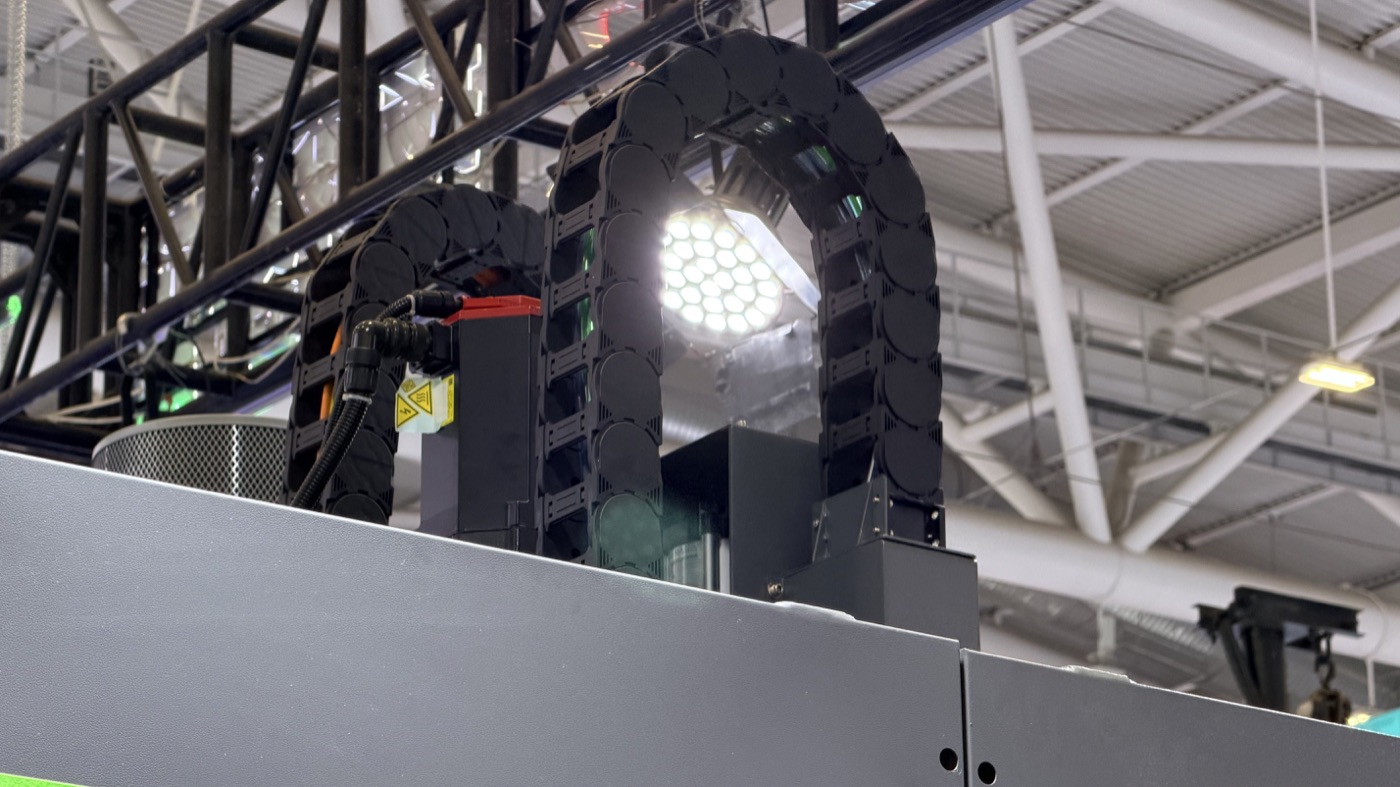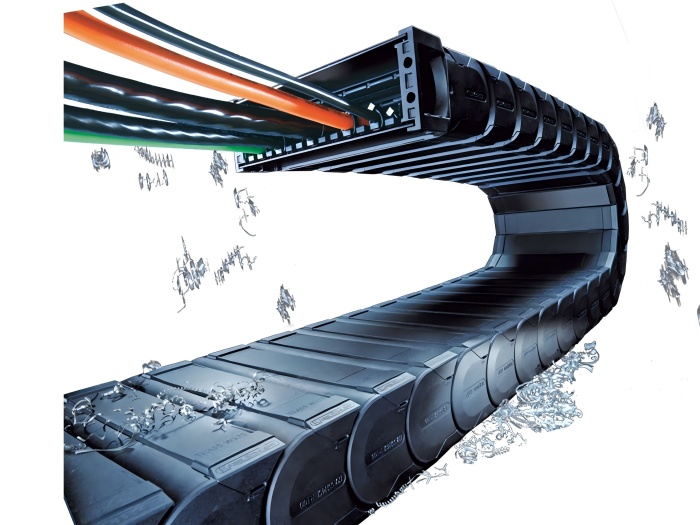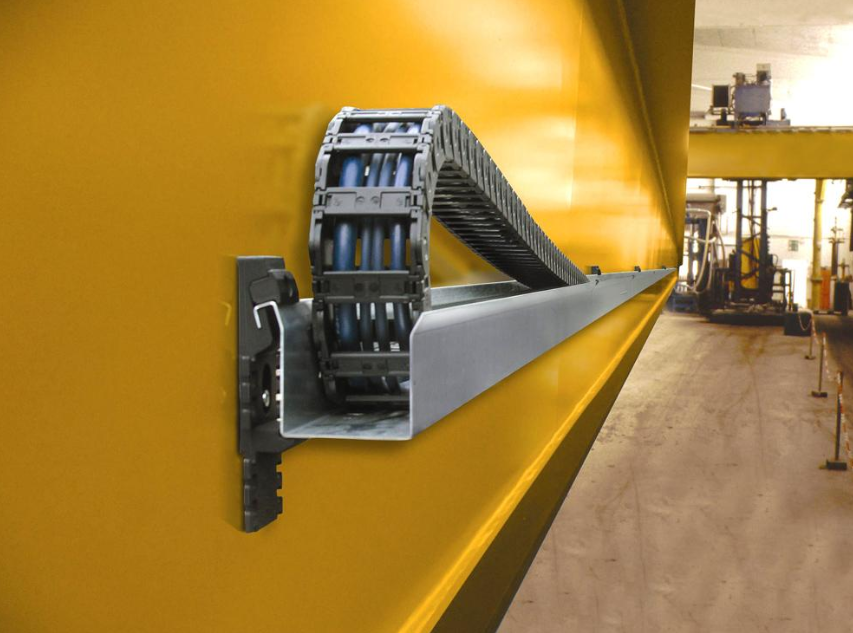
Overhead Crane Cable Management: Festoon, Trolley or Drag Chain
If you are specifying cable management for an overhead crane, the decision is usually not "which drag chain" but "which of three systems". A festoon with cable trolleys, a C-rail trolley system, and a cable carrier (drag chain) each own a different band of travel length, and picking outside that band is where most crane cable problems start.
This page gives the numbers behind that choice: the travel bands where each system stops working, the chain length formula with three worked examples, the four loads a crane puts on a carrier that a machine-tool carrier never sees, and the two things that arrive on site wrong most often — the cut length and the cable routing.
One disclosure up front, because it affects how you read the rest: we build cable carriers, not festoon systems. Where a festoon is the honest answer, this page says so.
The three ways to get power to a moving trolley
Every crane cable system does the same job — keep power, control and data attached to something that travels 10 to 400 metres, hundreds of times a day. The three common answers differ in what carries the cable and what takes the wear.
| System | What carries the cable | Typical travel band | What wears out first | Best fit |
|---|---|---|---|---|
| Festoon with cable trolleys | Trolleys rolling on a tensioned wire or C-rail, cable loop hanging between them | up to roughly 100 m | Trolley wheels, cable jacket at each saddle | Long spans, few cables, indoor, low duty cycle |
| C-rail / conductor rail | Fixed conductor with a sliding pick-up | any length, but power only | Collector carbon, rail joints | Power-only runs, no signal, no hose |
| Cable carrier (drag chain) | Links that guide the cable in a fixed bend radius | 6 m to 400 m and beyond, gliding above about 35 m | Link joints on the gliding run, cable jacket at the bend | Many cables, signal + power + hose, high duty cycle, tight headroom |
The trade is not quality. It is where the wear lands. A festoon spreads wear across many small trolley wheels and lets the cable hang almost straight. A carrier concentrates the wear at one moving bend but keeps every cable at a known radius, every cycle, for millions of cycles. If the crane runs 20 times a day, the festoon's wear spread is an advantage. If it runs 2,000 times a day, the carrier's controlled bend is the only thing that survives.
The chain length formula, and the mistake that costs a shipment
Carrier length is not travel length. It is half the travel plus the bend, and getting it wrong is the single most common reason a crane carrier cannot be installed on the day it arrives.
The working formula for a carrier mounted at the centre of travel:
Lk = S / 2 + K, where K = πR + 2T
- Lk — total chain length, mm
- S — travel stroke of the trolley, mm
- R — bend radius of the selected series, mm
- T — link pitch of the selected series, mm
For a carrier fixed at one end of the travel instead of the centre, the length becomes Lk = S + K. Getting the mounting position and the formula out of step is the second most common error.
| Case | Stroke S | Series | R | Pitch T | K = πR + 2T | Chain length Lk | Links needed |
|---|---|---|---|---|---|---|---|
| Small workshop crane | 12,000 mm | HXSD35, 45 mm inner height | 150 mm | 72 mm | 615 mm | 6,615 mm | 93 links |
| Standard overhead crane | 40,000 mm | HXSD41, 60 mm inner height | 200 mm | 91 mm | 810 mm | 20,810 mm | 229 links |
| Heavy gantry, high load | 40,000 mm | HXSD47, 80 mm inner height | 250 mm | 111 mm | 1,007 mm | 21,007 mm | 190 links |
The wrong version of this formula — Lk = S + 2πR — appears in a lot of supplier literature and in more than one published crane specification. On the 40 m case above it returns 41,257 mm instead of 20,810 mm: exactly double, which means the order arrives with twice the chain and no way to fit it.
Two checks worth running before the order goes out. First, confirm whether the carrier mounts at the centre or at one end of the stroke — the two cases differ by half the travel. Second, confirm that R is the radius you actually need for the cables, not the smallest radius the series offers. That is covered below.
Travel bands: where each system stops working
The bands below are practical limits, not catalogue limits. They assume a plastic carrier running in a steel guide channel, and a festoon on a tensioned wire rope.
| Travel stroke | Recommended system | Why the alternative fails here |
|---|---|---|
| under 6 m | Carrier, self-supporting | A festoon needs a minimum span to keep the cable loop from kinking |
| 6 – 35 m | Carrier, self-supporting or with a short guide trough | Festoon works, but each additional trolley adds a wear point and a cable saddle |
| 35 – 100 m | Carrier, gliding in a guide trough | Self-supporting carriers sag past their rated unsupported length; festoon becomes a long train of trolleys with visible sag |
| 100 – 400 m | Carrier, gliding, with roller or slide support | Festoon needs intermediate anchors or a powered tensioning winch, and wind sway on outdoor cranes lifts trolleys off the rail |
| over 400 m | Segmented carrier runs, or cable reel | Single-run chain mass and push force exceed what one drive point can move reliably |
Two numbers drive the transition from self-supporting to gliding. The first is the unsupported length the series is rated for — beyond it the chain sags, the joints load unevenly, and the cable at the bend gets a changing radius. The second is push force: a gliding chain carries its own weight on the trough floor, so the drive point has to push the whole run. On a 100 m crane that is 100 m of chain plus cable mass, and the calculation belongs in the crane design, not in the carrier catalogue.
Four loads a crane puts on a carrier that a machine tool does not
A carrier sized for a CNC axis will fail early on a crane even when the cable count and the weight look identical. Four loads are different.
1. Start and stop shock. A crane trolley accelerates a hanging load, so the carrier sees a longitudinal shock wave every time the drive engages. On a 40 m travel, the chain is long enough that the shock arrives at one end while the other end is still moving. Series with thicker side plates and a larger pitch handle this better than fine-pitch series: HXSD41 runs a 91 mm pitch with 11 links per metre and is rated for 70 kg/m of cable load, against 14 links per metre and 45 kg/m for the 45 mm HXSD35.
2. Twist and sway. A trolley on a single girder can yaw under load, which puts a twisting load into the chain that a machine-tool carrier never sees. The countermeasure is a wider chain than the cable bundle alone would need, plus a guide trough that constrains the run to one plane. An undersized chain in a loose trough will climb the wall.
3. Outdoor UV, rain and salt. Port and yard cranes run in conditions that age a plastic carrier differently from an indoor machine. UV stabilisation and carbon black content matter more than tensile strength here. Salt does not attack the nylon body much, but it attacks every steel pin and every fixing, so the pin material and the trough coating are the parts to specify.
4. Dust and temperature. Foundry and cement cranes load the chain with abrasive dust that migrates into the joints. Wide-pitch, open-sided series clear dust better than tight-pitch closed designs. On the hot end, check the continuous temperature rating of the actual grade, not the short-term peak — a carrier that softens at the bend loses its radius and takes the cable with it.
| Series | Inner height | Inner width range | Bend radius range | Pitch | Links / m | Rated cable load | Crane use |
|---|---|---|---|---|---|---|---|
| HXSD35 | 45 mm | 50 – 400 mm | 75 – 300 mm | 72 mm | 14 | 45 kg/m | Workshop cranes, short travel |
| HXSD39 | 58 mm | 50 – 400 mm | 100 – 350 mm | 72 mm | 14 | 65 kg/m | Standard overhead cranes |
| HXSD41 | 60 mm | 75 – 500 mm | 135 – 350 mm | 91 mm | 11 | 70 kg/m | Long travel, heavy cable bundle |
| HXSD43 | 85 mm | 75 – 500 mm | 150 – 600 mm | 111 mm | 9 | 83 kg/m | Gantry, RTG, large power cables |
| HXSD47 | 80 mm | 75 – 500 mm | 150 – 1,000 mm | 111 mm | 9 | 83 kg/m | Very long travel, high cable load |
Pre-harnessed carriers: the cables arrive already inside
Fitting cables into a 20 m carrier at height, on a crane that is already erected, is the part of the job that goes wrong. Access is bad, the chain hangs in a loop, and every cable has to be pushed through 229 links without exceeding its bend radius at any point.
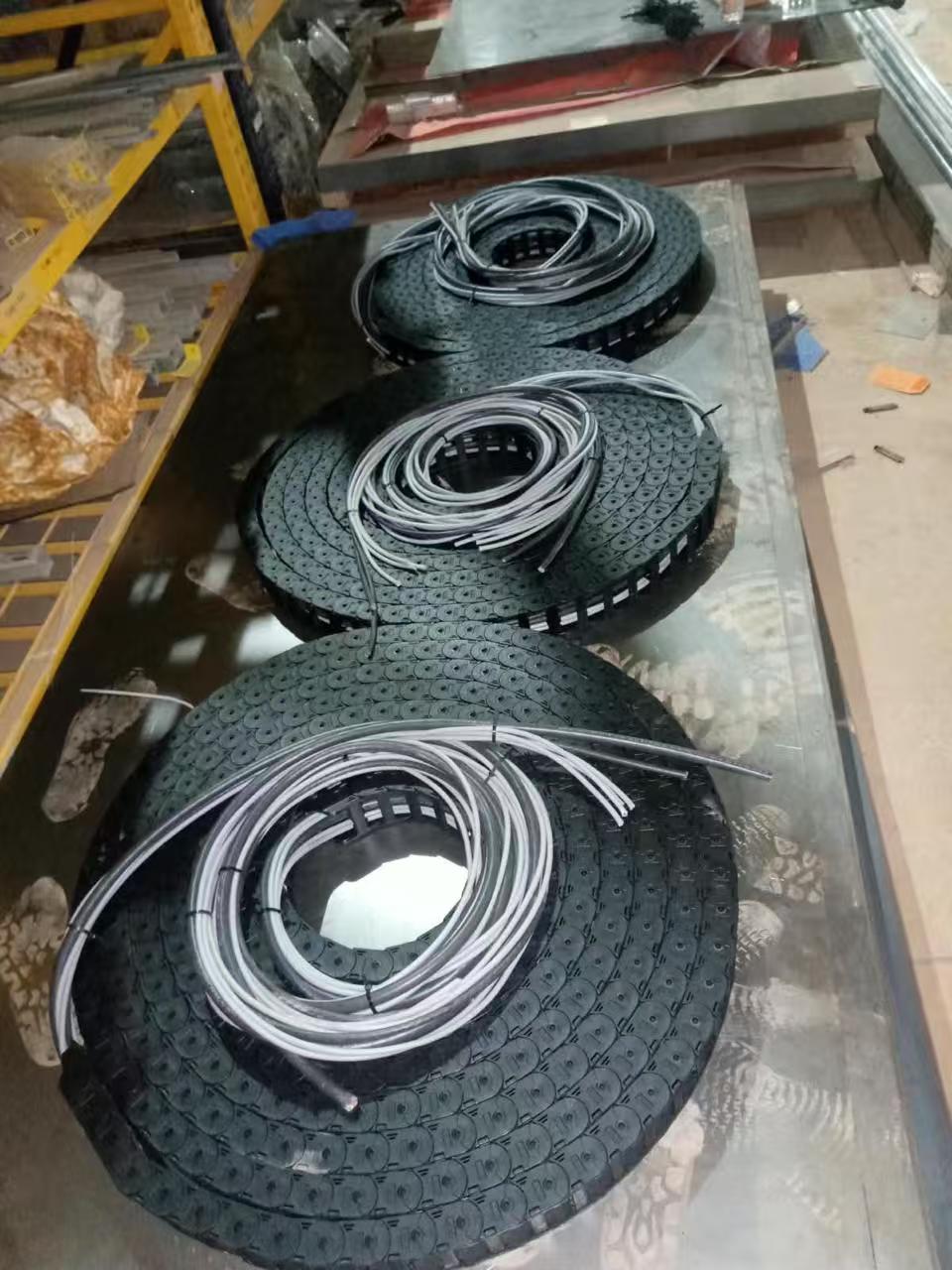
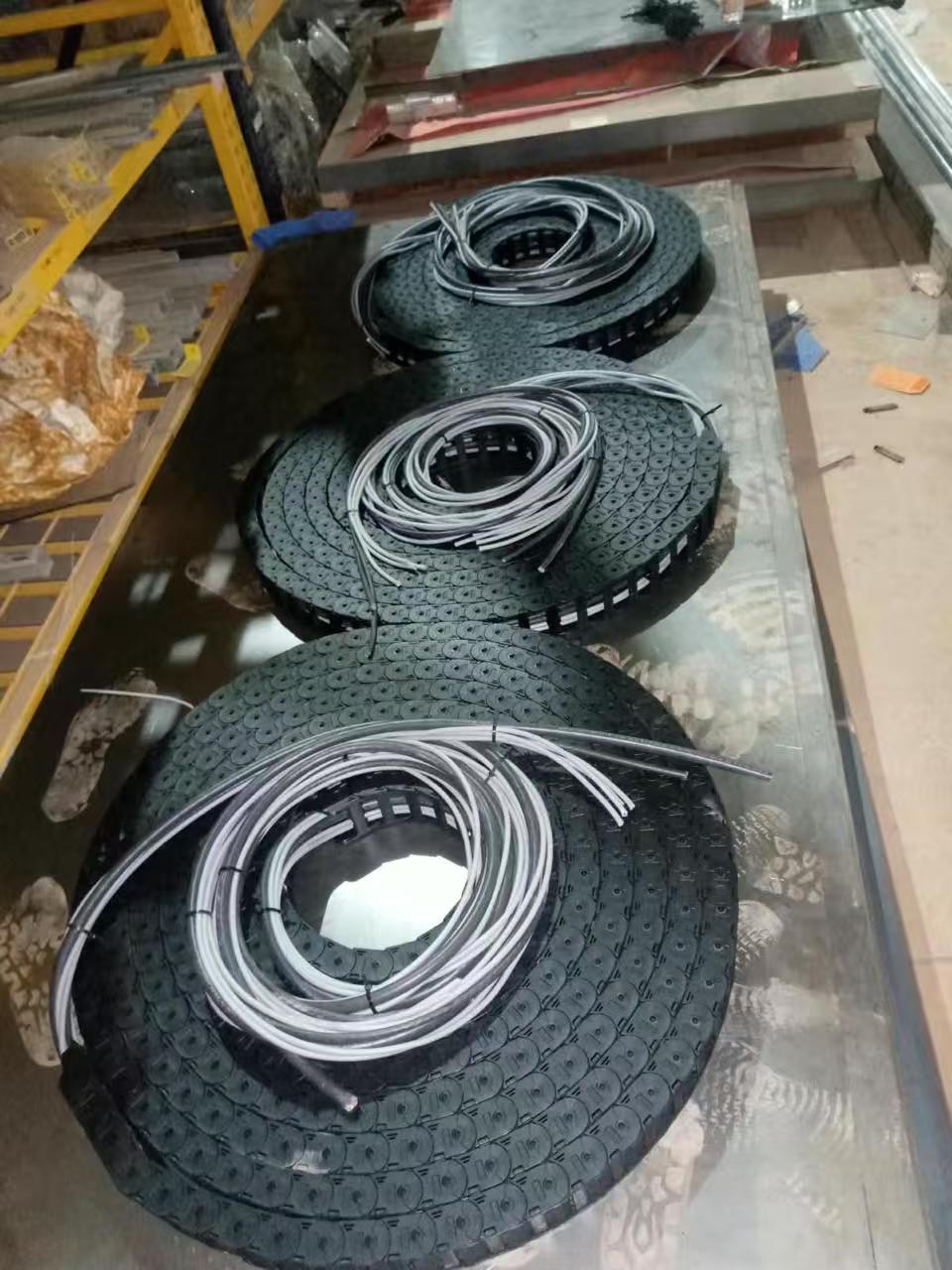
The photo above shows the alternative: carriers loaded at the factory, coiled with the cable already threaded, ready to hang. Three things change when the harness is built before shipping instead of on site.
- The bend radius is verified once, at the factory. Each cable is laid into the chain at the selected R and the assembly is run through a full open-and-close cycle. If a cable is too stiff for the radius, it is found at the bench, not 12 m up.
- Separators and strain relief are fitted at the correct spacing. Vertical stacks get separators every two links, and the cable is clamped at both ends so the pull is taken by the clamp instead of the conductor. Both are easy to skip when the fitter is working overhead.
- On site the work is hanging and fixing, not threading. The coil goes up as one assembly, the fixed end bolts to the bracket, the moving end to the trolley. A job that takes a shift becomes a job that takes an hour.
Pre-harnessing has one hard requirement: the cable list has to be final before the chain is built. Changing one cable afterwards means opening the chain, which is why we ask for the cable schedule with outside diameters and weights, not just a count.
Length is cut to the calculated total, not to a round number
Crane carriers are not sold by the metre from stock. Each run is cut to the figure the formula returns, which is why shipped lengths carry decimals.
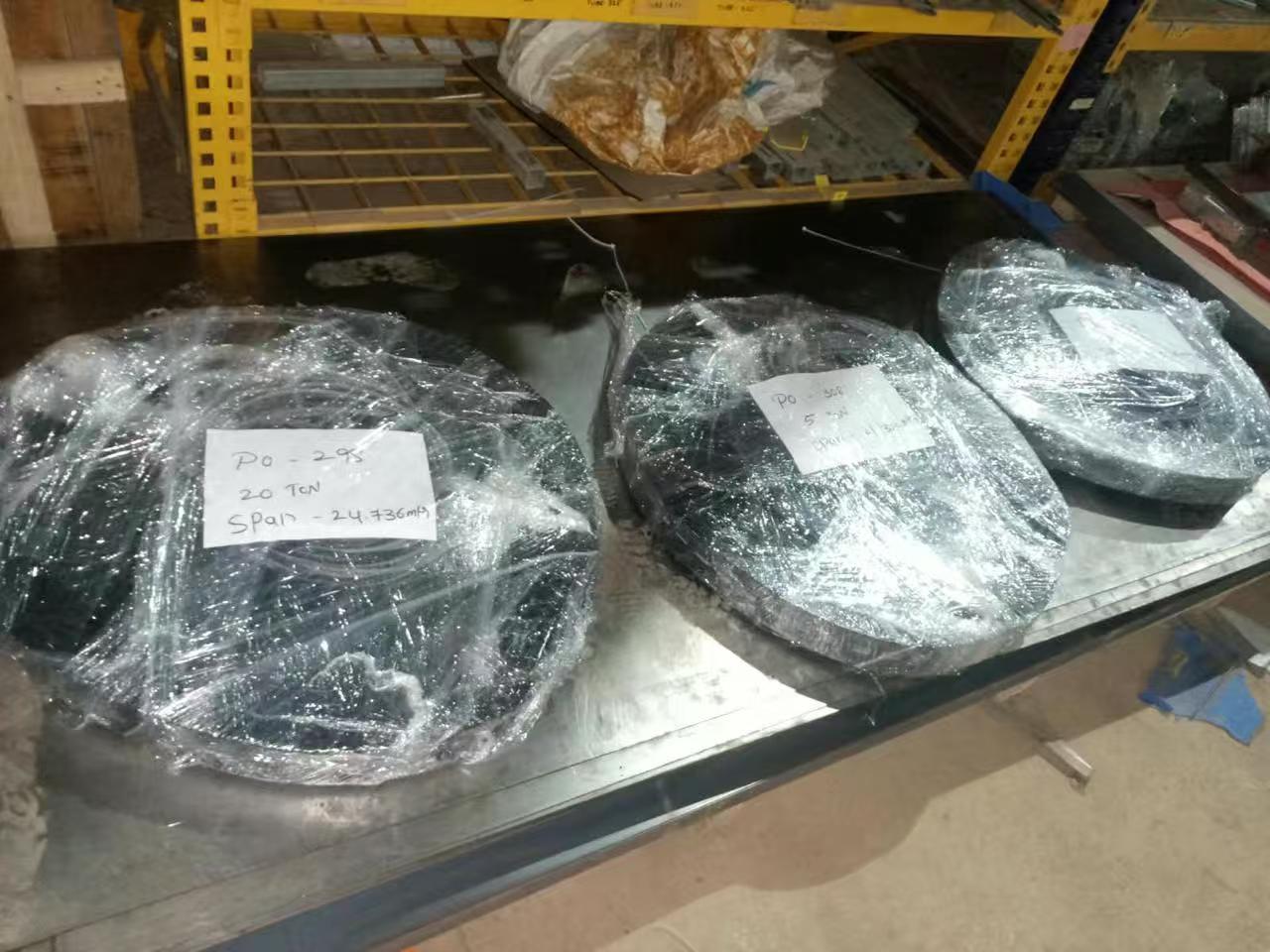
The coils above are wrapped and labelled before dispatch. One label reads 24.736 m — not 24 m, not 25 m. That number is not a rounding artefact; it is the output of the length calculation for that specific stroke, radius and pitch, converted to metres and cut.
This is worth stating plainly because the failure mode is asymmetric. A chain 200 mm too long can sometimes be shortened on site by removing links, if the end brackets allow it. A chain 200 mm too short cannot be extended — the run has to be returned or a joint fitted, and a joint in a gliding crane run is a wear point for the rest of its service life.
Three things to do with the label when the crate is opened:
- Check the length against the drawing before unwrapping. Coils look alike.
- Check that the coil count matches the number of runs on the crane — a dual-girder crane with a separate carrier for the trolley and the bridge needs two.
- Keep the label with the crane documentation. If a replacement is ordered in three years, that number is the specification.
ATEX and Ex zones: what actually changes
This is the point where crane specifications most often ask for the wrong thing, so it is worth being precise about what a hazardous area changes and what it does not.
In an Ex-rated area, three properties of the cable system come under review:
- Static charge. A plastic carrier sliding on a plastic or painted surface can accumulate charge. Conductive or antistatic grades, plus a defined earth path through the fixing brackets, are the usual answer.
- Surface temperature. The rating is set by the zone's gas or dust group. A carrier running continuously in a hot enclosure is a different case from one running intermittently in ambient air.
- Friction and impact sparking. This is where metal-to-metal contact matters — steel chains, steel guide troughs and steel trolley wheels all need review in a zone where a spark is a hazard.
What this means in practice for a project that asks for an "ATEX festoon for crane": the festoon is the traditional answer in Ex areas because the cable hangs free and the trolleys are few, and many Ex-rated festoon systems exist as certified assemblies. If the project instead needs a cable carrier in the zone, the carrier has to be assessed against the same three points, and the assessment has to name the zone, the gas or dust group, and the temperature class.
Our position, stated honestly: our standard carriers are not supplied as ATEX-certified assemblies. Where a project needs a certified energy chain for a hazardous area, we will say so at quotation stage rather than ship a standard chain with a certificate number bolted on. If your Ex-zone crane can use a festoon, a certified festoon supplier is the right call, and we will tell you that.
Port, RTG and ship-to-shore cranes: the salt and wind problem
Container handling is the most demanding crane application for cable management, and the reasons are specific rather than general.
Travel is measured in hundreds of metres. An RTG stack run or a ship-to-shore gantry can exceed 300 m. At that length a plastic carrier must glide in a trough with roller or slide support, and the push force calculation becomes a structural question about the trough, not a carrier question.
The environment is salt, sun and wind. Salt spray reaches the trough floor and stays there as an abrasive paste. Wind load on a 300 m run of chain in a trough is a design input. UV exposure is continuous, which is why carbon-black-filled grades are specified rather than natural nylon.
Maintenance windows are short. A quay crane cannot be taken out of service for a week to replace a chain. Systems are chosen for what can be swapped in a shift, and that favours carriers with open, accessible joints over enclosed designs that need the run to be dismantled.
For very long outdoor runs, a steel carrier is often the better answer than a plastic one: the higher mass is an advantage once the run is supported, and the temperature and UV questions disappear. We list the steel range separately for exactly this case.
Five mistakes we see in crane carrier specifications
- Using cable length as chain length. The carrier is not as long as the cable, and it is not as long as the travel either. It is S/2 + K.
- Dropping the 2T term. The pitch term looks small — 182 mm on a 40 m run — but it is the difference between a chain that closes cleanly and one that runs out of links at the bracket.
- Specifying R from the series minimum. The minimum radius in a catalogue is the tightest the chain can bend, not the radius the cable needs. For a continuous-flex cable, size R at 7.5 to 12.5 times the cable outside diameter — 7.5 for a short service life in a low-cycle crane, 12.5 for maximum cable life — then pick the nearest available R above it.
- Overfilling the chain. Above roughly 55% fill of the inner cross-section, cables cannot move, heat builds up, and the bundle acts as a solid block that fights the bend. A wider chain is cheaper than a rebuilt cable harness.
- Ordering a round number. A 20 m chain for a run that calculates to 20.81 m will not fit. Order the calculated figure.
What to send us for a crane carrier quotation
Six inputs decide the whole specification. With these, a quotation is a calculation rather than a guess.
| Input | Why it matters | Example |
|---|---|---|
| Travel stroke and mounting position | Sets the length, and whether the formula is S/2 + K or S + K | 40,000 mm, carrier fixed at mid-travel |
| Cable and hose schedule with outside diameters | Sets the chain width, the fill ratio and the minimum radius | 4 × 22 mm power, 2 × 12 mm control, 1 × 25 mm hose |
| Total cable weight per metre | Must stay inside the series rating — 45, 65, 70 or 83 kg/m | 6.8 kg/m |
| Travel speed and cycles per hour | Decides self-supporting versus gliding, and the duty class | 80 m/min, 25 cycles/hour |
| Available height above the mounting plane | Installation height is inner height plus a fixed allowance per series | 600 mm clear |
| Environment | Outdoor, dust, salt, temperature, Ex zone | Outdoor, coastal, −10 to +45 °C |
If the crane is already built and the question is a replacement, the label on the old coil plus a photo of the mounting bracket usually replaces half of this list.
内链块之前(无内链块则追加到正文末尾) 占位符说明: Specifying a crane carrier where travel and headroom fight each other? = 提问式标题,一句,针对本文主题(≤70 字符),结尾问号 Send the travel stroke, whether the carrier mounts at mid-travel or at one end, the cable schedule with outside diameters and weights per metre, the travel speed, and the clear height above the mounting plane. Our engineers usually reply within one working day with the bend radius, the cut length and the separator layout. = 让客户提供哪些参数 + 承诺「usually within one working day」由工程师回复 链接固定://www.sondadragchain.com/contact-us.html 与 //wa.me/85247504731,勿改 -->Related reading
- Drag chain size calculation: stroke, radius and link count with worked examples
- Unsupported length: when a carrier needs a guide trough
- Crane drag chain basics: what a carrier does on a lifting machine
- Cable chains for hoist systems
- Steel drag chain range for long outdoor runs
- Heavy duty carrier range: HXSD35 to HXSD47
Dynamic Cable Carrier & Modular Cable Carrier Solutions by SONDA – Compact 5mm Mini Drag Chains for Robotics & Global Automation