Top Cable Drag Chains for 2026: Five Machine Types Compared
Most "best drag chain" lists are catalogue pages with a year in the title. This one is not. It works from the four numbers that decide whether a chain survives in a given application, and it separates the five machine types that have genuinely different answers.
The selection criteria have not changed. What has changed is the supply side — stock depths, realistic lead times and the spread between a commodity quote and a premium one. Those are covered further down, because in practice they decide more purchases than the engineering does.
Five applications, five different primary constraints
The mistake almost every buyer makes is to compare chains on a single axis — usually price, sometimes "quality". In reality each machine type is limited by a different parameter, and optimising the wrong one produces a chain that fails early while scoring well on the comparison sheet.
| Application | Primary constraint | What that means for the specification | Typical inner height |
|---|---|---|---|
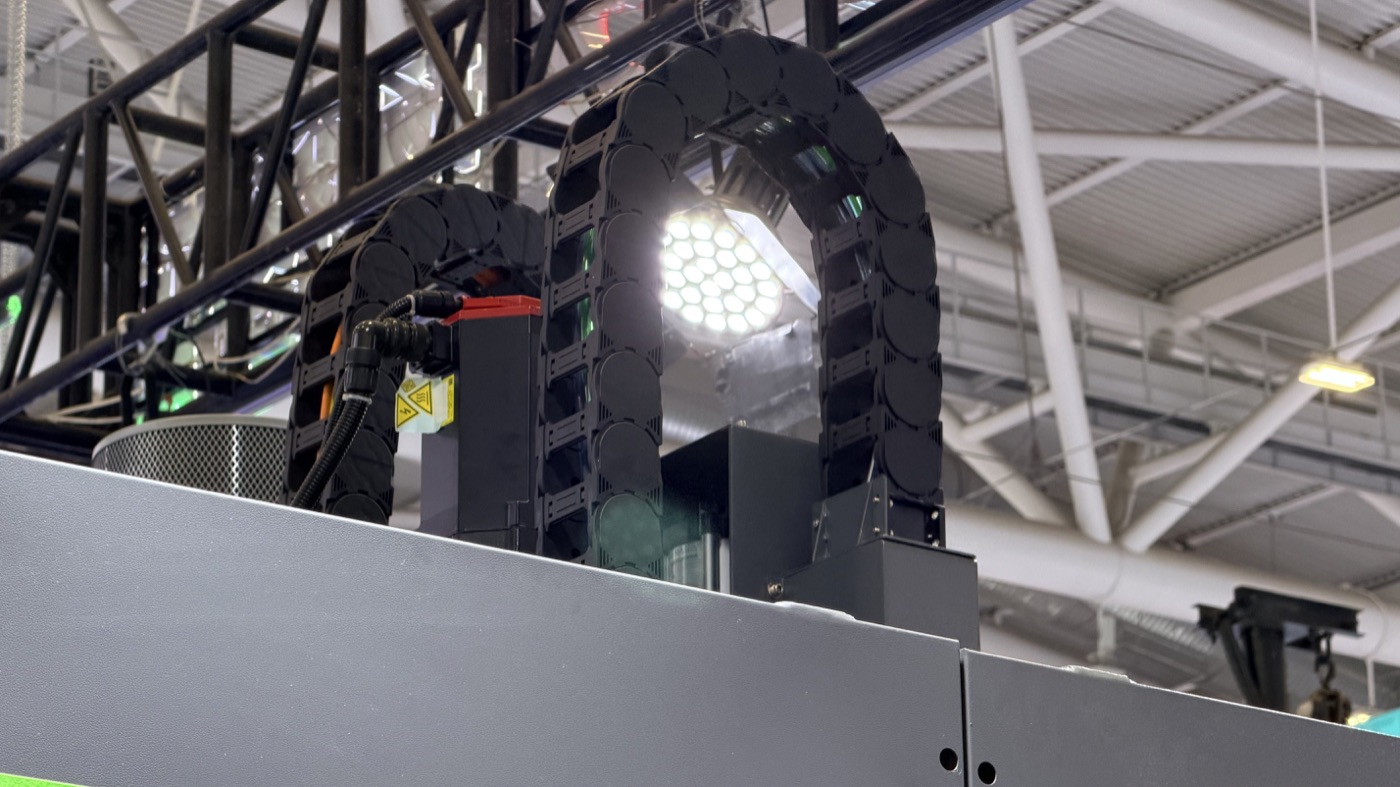
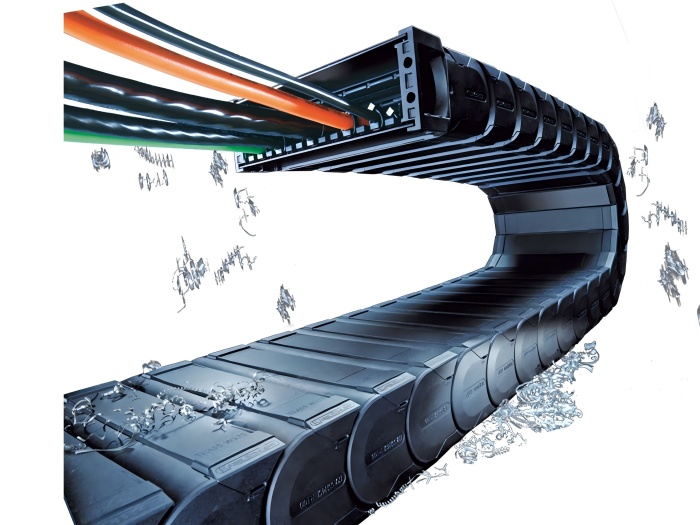
| CNC machine tool, flood coolant | Chip ingress and coolant attack | Closed or tube-type chain; POM or glass-filled grade rather than unfilled PA66 if the chain sits in the coolant stream | 30 to 60 mm |
| Industrial robot, high cycle | Acceleration and torsion | Short pitch for smooth running, high torsional stiffness, continuous-flex cable rated 7.5 × d or better | 20 to 40 mm |
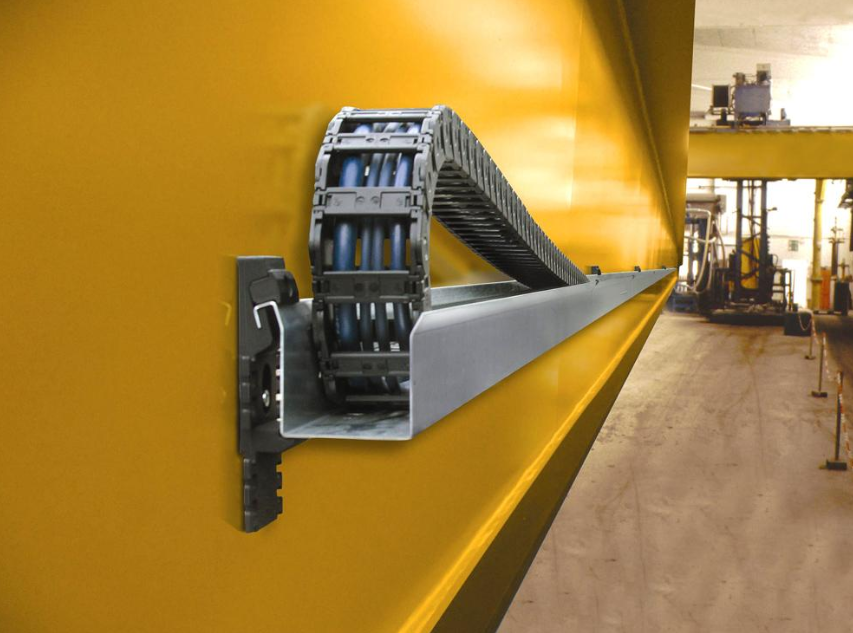
| Long-travel gantry or crane | Unsupported span, then gliding wear | Guide trough or rollers, plus roughly 10% extra length for the moving-end radius | 35 to 80 mm |
| Cleanroom or semiconductor | Particle emission | Unfilled PA66 or electropolished stainless; glass-filled material is disqualified regardless of strength | 17 to 40 mm |
| Desktop router or 3D printer | Available installation height | Small radius chain plus a flexible cable, because the machine cannot provide the radius the general rule demands | 10 to 20 mm |
Read down the "primary constraint" column and the reason for the price spread becomes obvious: a cleanroom chain and a machine-tool chain can be dimensionally identical and still not be interchangeable, because one is optimised for what it releases and the other for what it resists.
A four-step filter that removes most of the noise
Before comparing prices, four numbers have to be fixed. They come from the machine, not from the catalogue.
Step 1 — travel. The axis stroke, in millimetres. This is the number everything else is derived from, and it is the one buyers most often take from a drawing instead of measuring on the machine.
Step 2 — chain length. Travel is not length. A fixed end at mid-travel needs Ls/2 + πR + 2a; a fixed end at one end of the stroke needs Ls + πR + 2a. Getting this wrong by a factor of two is common in RFQs.
Step 3 — bend radius. The stiffest cable sets it: at least 10 × its outer diameter under the general engineering rule, or 7.5 × to 12.5 × for purpose-built continuous-flex cable. The cable datasheet always overrides the rule of thumb.
Step 4 — inner width and height. Inner height from the largest single cable plus 10% clearance for round cable, 20% for hydraulic hose. Inner width from the sum of the bundle plus separators. Keep loose stacking below 1.5 × cable diameter.
Only after those four are written down does a quotation mean anything. A supplier quoting on a model name rather than on those four numbers is guessing, and the guess will be resolved on installation day.
Price bands in 2026, and how to read a quote
Commodity PA66 bridge-type chain in the most common size — roughly 45 mm inner height by 75 mm inner width, R75 — trades in a known band on the Chinese market:
| Order quantity | Typical unit price | What changes at this quantity |
|---|---|---|
| 100 m | US$5 to 12 per metre | Standard moulds, stock colours, no tooling charge |
| 1,000 m | US$3 to 5 per metre | Commodity widths only; setup cost fully amortised |
| Non-standard inner width | Band plus tooling | New mould; ask whether it is charged once or amortised, and who owns it afterwards |
Three readings of a quote are worth more than the number itself:
- Well below the band at 100 m usually means regrind content, thinned side plates, or a smaller hinge pin. Ask which one, and ask for a section photo.
- Well above the band is normal for a filled or flame-retardant grade, a stainless hybrid, or a small quantity where setup dominates the price.
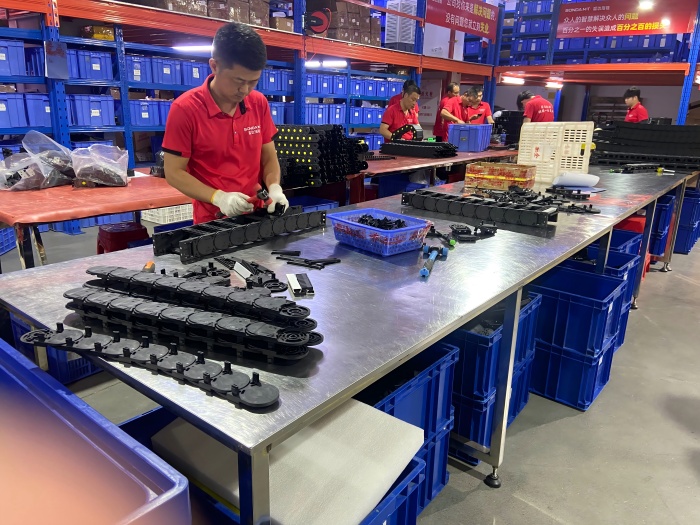
- Five suppliers quoting almost identically while all claiming to be factories usually means one factory and four traders. Ask for a photo of the mould in the press.
The tooling question deserves its own line. A new inner width means a new mould, and the mould outlives the order. Ask who owns it at the end of the project — the answer decides whether you can move the part to a second source in three years or whether you are locked in.
Lead times: the three real bands
Lead time is where buyers most often get an optimistic number and then a delayed shipment. In practice Chinese supply clusters around three bands, and a promise far outside them is worth questioning.
| Order type | Realistic lead time | Why |
|---|---|---|
| Stock sizes, 45 to 60 mm, ex-Shanghai | 1 to 2 weeks | The chain already exists; the work is picking and packing |
| Custom inner width or non-standard radius | 3 to 4 weeks | Mould change or new mould, then a first-article check |
| European openable hybrid, field-serviceable design | 6 to 10 weeks | A different supply base entirely |
The dominant cluster for commodity chain is Hebei and Shandong, which is why "one week" and "two weeks" are the two numbers you will hear most. Three days on a custom width means either the supplier already holds stock in that width, or you are about to receive something else.
Where the money is actually worth spending
Four upgrades pay for themselves. Everything else is usually decoration.
The floating bracket. A chain has a fixed end and a moving end, and the moving end must float sideways, because no machine's rails are perfectly parallel over a full stroke. Hard-mount both ends and the chain is forced to twist as it travels — link wear on one side, then a crack, typically within the first two shifts of production.
Strain relief within the first 200 mm of the moving termination. The chain guides the cable; it must not pull on it. Without a clamp, the acceleration load is carried entirely by the connector pins, and the failure appears as an intermittent fault that nobody can trace until a cable comes out of a connector at an emergency stop.
Continuous-flex cable instead of standard cable. The cable usually fails before the chain does, and the router or motor lead is almost always the first to go. A 7.5 × d rated lead often costs less per metre than the downtime it prevents.
A guide trough once the span is exceeded. The unsupported length a chain can bridge shrinks as fill weight rises. Past that limit the upper run sags, drags, and induces a fatigue bend at the fixed end. A trough plus the extra 10% length is cheaper than the alternative, which is replacing chains on a schedule.
Where the money is not worth spending: higher series ratings for a machine that never approaches them. A vertical machining centre rapid-traverses at 0.5 to 1.0 m/s against a polymer chain rating of about 5 m/s continuous. If the original chain lasted eight years, the speed envelope was never the problem, and buying a stronger chain of the same geometry will not extend the next one.
What to do with all of this
The list of "best" chains for 2026 is really a list of correct matches. The five application types above have different primary constraints, so a chain that wins on one row can be disqualified on another. Fix travel, chain length, bend radius and fill dimensions first; then compare quotes, and treat the price band and the lead-time bands as diagnostics rather than as targets.
For the arithmetic behind step 2 and step 3, drag chain size calculation and bend radius calculation work both through with numbers. If you are replacing a chain rather than specifying a new machine, the six dimensions to match on a replacement is the shorter path. And before placing a first order with an unfamiliar supplier, the twelve-point supplier audit covers what to verify in writing.

Comparing the chains on this list for your machine?
Send us the machine type, stroke and cable load. Our engineers reply with which series fits and the specification to order, usually within one working day.
Related reading
Igus Cable Chain Alternatives: Six Ways to Replace an E2 Mini
Compact Enclosed Cable Carriers: SONDA vs igus for Packaging Machinery