CNC Drag Chain Replacement: Six Dimensions to Match
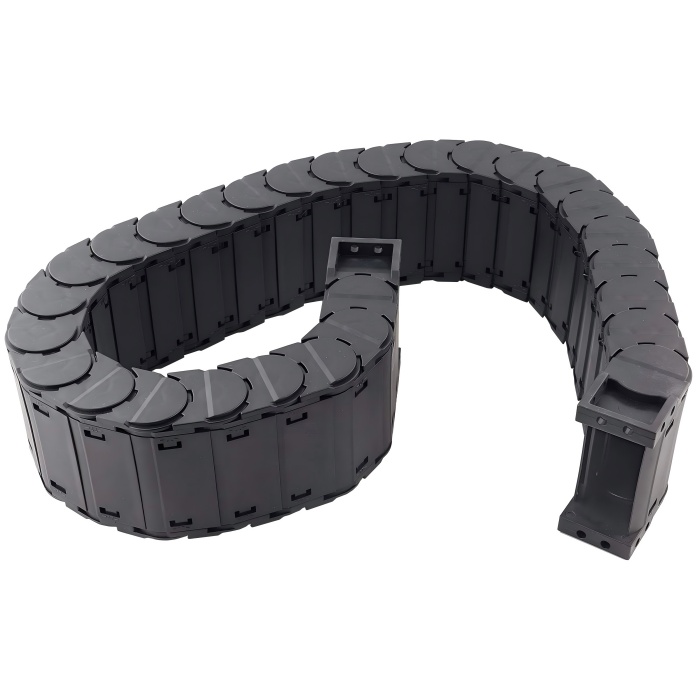
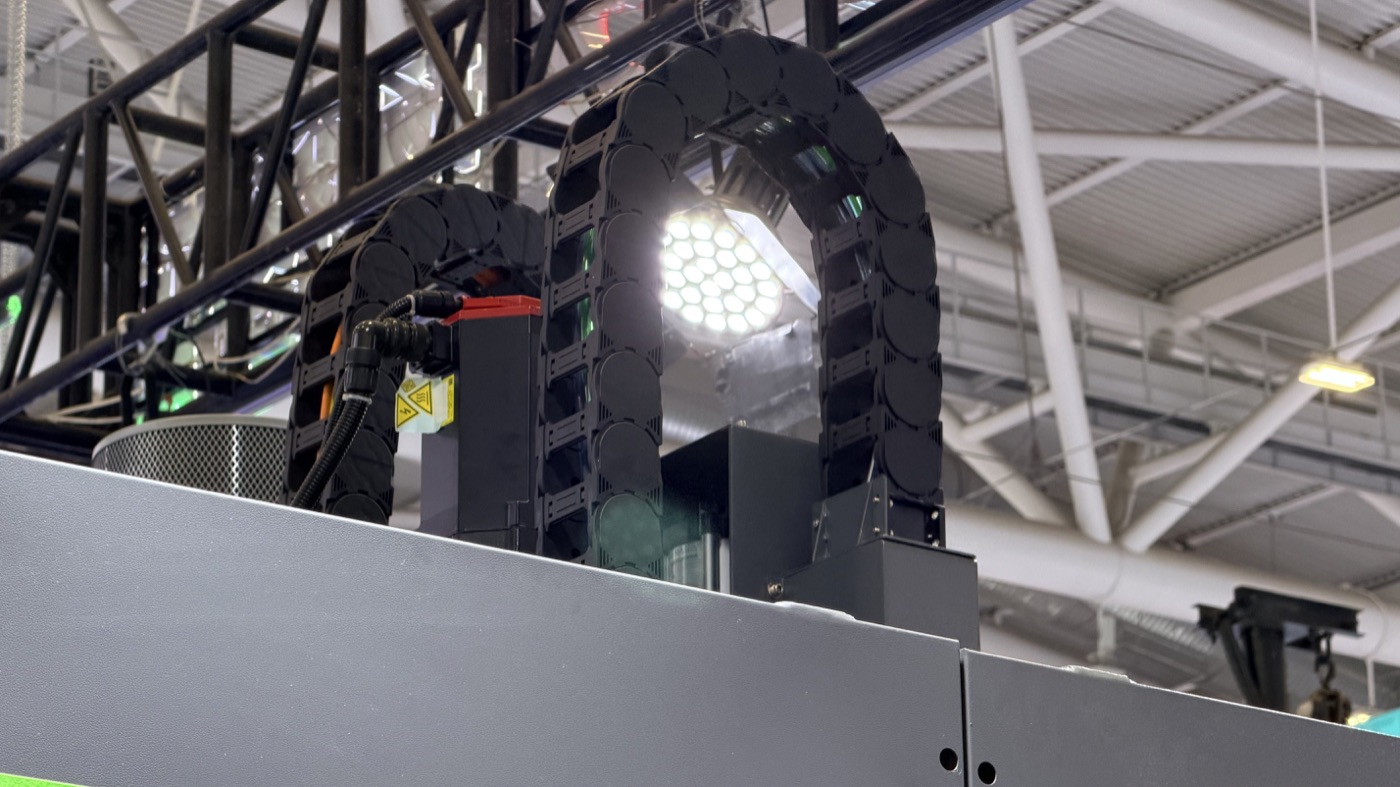
Replacing a drag chain on a CNC machine is not a selection exercise. The machine already decided the geometry years ago; the job is to read that geometry off the worn part and find something that matches it before the machine is back in production.
This page is about that reading — the six dimensions that have to be measured, the one that most often gets missed, and the material question that decides whether the replacement lasts two years or ten.
Start from the cost of being down, not the cost of the chain
A commodity chain on a small machining centre costs somewhere between fifty and a few hundred dollars. An hour of lost spindle time on the same machine costs many times that, and a missed delivery on a contract part costs more again. This ratio sets the entire strategy: the objective is not the cheapest chain, it is the shortest possible time between noticing the failure and running again.
Two consequences follow, and both are decisions made before the failure:
- Keep a spare on the shelf for any machine where a chain failure stops production. The spare does not have to be the premium option; it has to be the correct length and the correct end fittings, already in the building.
- Write the six dimensions down now, from the chain that is currently running, while it is still running. Measuring a worn chain after it has cracked is measurably harder, because a failed link has usually lost its true pitch.
The six dimensions to record
Everything else about a drag chain can be inferred once these six numbers exist. Record them for every chain on the machine — typically X, Y and Z — because they are rarely the same.
| # | Dimension | How to measure it | What it fixes |
|---|---|---|---|
| 1 | Pitch | Centre-to-centre distance of two adjacent hinge pins, averaged over 10 links, then divided by 10 | Chain length resolution and whether spare links from another batch will join |
| 2 | Inner height | Clear opening between the crossbar and the base plate | Whether the existing cable bundle fits without being crushed |
| 3 | Inner width | Clear opening between the two side plates | Number of cables per layer, and separator positions |
| 4 | Bend radius | Measure the arc on an assembled, loaded chain — not from a drawing | The single number that decides cable jacket life |
| 5 | Link count | Count every link, including the two end links | Chain length; multiply by pitch to cross-check |
| 6 | End fitting bolt pattern | Hole spacing, hole diameter, and the height of the mounting face relative to the chain centreline | Whether the replacement bolts onto the existing brackets at all |
Number six is the one that ruins orders. Two chains can be dimensionally identical in pitch, height, width and radius and still not fit, because one mounts with two M5 screws at 40 mm centres and the other with two M6 at 50 mm, or because the mounting face sits 8 mm above the chain centreline on one and 12 mm on the other. Measure the bracket, not just the chain.
Opening style: the specification nobody writes down
How the chain opens determines whether you can install cables at all, and it is almost never in a purchase description. There are three common arrangements:
| Style | Behaviour | When it is the only workable choice |
|---|---|---|
| Non-openable | Crossbars are moulded into the side plates | Never for retrofit — cables must be threaded from the end before assembly |
| Openable on the inner radius | Crossbars hinge from the inside of the bend | Retrofit where the chain sits close to the machine frame and the outer face is inaccessible |
| Openable on the outer radius | Crossbars hinge from the outside of the bend | Retrofit where the chain is accessible from above — the usual case on a gantry |
If the machine's existing chain opens on one side and the replacement opens on the other, you will find out during installation, with the machine apart. Ask the question in the RFQ in plain words: which radius opens, and does the model I am being quoted open at all.
Material: what a CNC environment actually does to a chain
Machine tools are one of the harsher environments for a polymer chain, and the failure modes are specific.
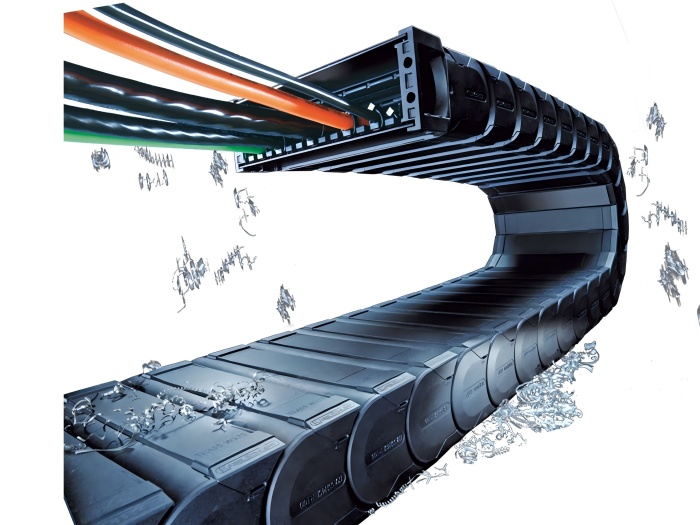
Chips, not load, kill most chains on a machining centre. Cast iron and aluminium chips are sharp, and they pack into an open crossbar chain until the links stop articulating fully. Once the chain stops articulating, it stops distributing the bend over many links and starts bending at one or two, which is the beginning of the end. Closed or tube-type designs, or a scheduled blow-down, are the two answers; there is no third that avoids both.
Water-miscible coolant is a genuine material problem. PA66 absorbs moisture, and in the presence of heat and long-term contact with water-based coolant it is susceptible to hydrolysis — the polymer chains break, and the symptom is a chain that goes brittle and whites at the surface rather than one that wears smooth. Flood-cooled machines running two or three shifts are exactly the application where this shows up. If the chain lives in the coolant stream, the material conversation should include POM, a glass-filled grade, or a stainless chain rather than defaulting to unfilled PA66.
Glass-filled PA66 is the right answer here and the wrong answer in a cleanroom. 30% glass fibre raises stiffness and tensile strength and improves dimensional stability under heat, which is exactly what a machine tool needs. The same fibres break free at wear points and become airborne particulate, which disqualifies the material for semiconductor and pharmaceutical applications. Reinforcement is an application decision, not a quality grade.
Steel earns its place in specific conditions — high heat, weld spatter, heavy fill, or travel where a polymer chain would need an unsupported span beyond its rating. It costs noise, weight and corrosion management, and it is not automatically the more durable choice: a stainless chain with poor joint clearance can wear faster in an abrasive environment than a well-filled polymer chain.
Speed and acceleration limits, and where a CNC sits against them
Polymer energy chains in this class run continuously at up to roughly 5 m/s with accelerations of 50 m/s² and above, with the exact ceiling set by series, fill weight and length. Test-rig figures on high-end series reach far higher — documented short-stroke peaks near 22 m/s and 784 m/s² — but those are rig numbers over limited cycles, not continuous ratings.
Put a machining centre against that envelope. A typical vertical machining centre rapid-traverses at 30 to 60 m/min, which is 0.5 to 1.0 m/s, with accelerations around 0.3 to 1 g. A high-speed drill-tap machine or a fast gantry router might reach 60 to 120 m/min, still under 2 m/s. In other words, speed is almost never the limiting factor on a CNC machine tool — acceleration, fill weight and the unsupported span are, and acceleration is what excites vibration in a long unsupported run.
That matters for replacement because it changes which number to argue about. If the original chain lasted eight years, the speed envelope was fine and the replacement does not need to be a higher series. If it lasted eighteen months, the problem is almost certainly chips, coolant or an unsupported span, and buying a "stronger" chain of the same geometry will produce the same eighteen months.
Unsupported span, and when you need a trough
The unsupported length — the free-air span the upper run can bridge — is the number that quietly limits long-travel machines. The span shrinks as fill weight rises, and once the chain exceeds it, the upper run sags, drags, and induces a fatigue bend at the fixed end.
The signs that a machine has crossed that line:
- The upper run visibly dips below level when the chain is fully loaded
- Wear marks appear on the lower run's outer face, where the upper run has been touching it
- The chain makes a slapping or slapping-then-scraping sound at one end of the stroke
- Link cracks cluster near the fixed end rather than distributed along the chain
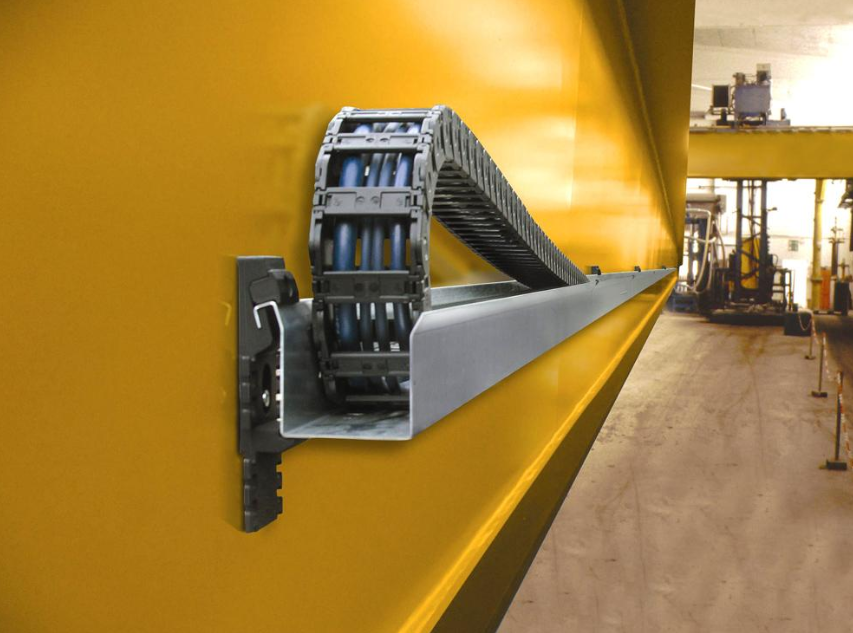
The fixes, in order of preference: reduce the fill weight by moving heavy cables to the bottom of the stack and removing unused conductors; add a glide shoe or rollers with a trough; and only then consider a larger chain. When a trough is added, allow roughly 10% extra chain length to account for the additional radius at the moving end.
Matching a replacement: the compatibility checklist
For a straight swap, six yes/no answers decide it. Anything less than six and you are designing, not replacing.
| Check | Compatible means |
|---|---|
| Pitch | Within a fraction of a millimetre; different pitch means the chain cannot be extended with existing links |
| Inner height and width | Equal or larger, with the existing bundle still able to move freely inside |
| Bend radius | Equal or larger than the existing, and still above the stiffest cable's rated minimum |
| End fitting pattern | Hole spacing, hole size and mounting face height all match, or a new bracket is quoted with the chain |
| Opening side | Opens on the radius you can actually reach on this machine |
| Chain length | Link count gives the same total installed length at both ends of travel |
Where a supplier cannot match the end fitting — the most common mismatch when changing brands — quote the bracket as a separate line rather than drilling the original. A bracket is a machined part costing less than an hour of downtime; a drilled bracket with an elongated hole is a permanent source of chain misalignment.
Spares: how many, and of what
Chain life is quoted in cycles, so convert your own machine into the same unit and work from there. One cycle is a full out-and-back of the axis. A machine running two shifts, 4,000 hours a year, averaging one traverse per minute, covers about 240,000 cycles a year. A three-shift high-volume cell approaches 500,000.
Against a rating in the low millions of cycles at moderate speed and fill weight, that suggests several years of life — which is why a chain that fails in year two on a two-shift machine is a signal about the environment, not about the chain. In practice, for a machine where a stop is expensive, hold one complete spare chain plus the two end brackets, and hold the two or three most-worn cable lengths as well. The cable usually fails before the chain does, and a spare chain without a spare router lead does not restart the machine.
For the calculation side — turning travel into chain length, and choosing inner width from the cable bundle — drag chain size calculation and bend radius calculation work through both with numbers. For the selection theory behind a new machine rather than a replacement, the CNC drag chain guide covers the full procedure, and this comparison of carrier designs explains where the mainstream European series and their equivalents actually differ.
If you are sourcing the replacement from a new supplier rather than the original machine builder, the questions worth asking before the first order are in the supplier audit checklist — twelve items, eleven of which a real factory can answer from documents it already has.

Replacing a CNC drag chain from another supplier?
Send us the original chain's inner height, inner width and bend radius, or a photo with a ruler in frame. Our engineers reply with the matching series and a replacement drawing, usually within one working day.
Related guides
- Shapeoko drag chain sizing for desktop routers
- Reading a drag chain size chart without guessing
- ATEX and IECEx: what is actually certified in a cable carrier
- Drag chain size calculation with worked examples
- Matching a chain to your CNC travel
- Igus E2 replacement options
- Which chain type fits which machine
CNC Drag Chain Guide: Routing, Installation & Materials
Cleanroom Energy Chains: ISO 14644 Class, Materials & ESD