ATEX Certified Festoon Cable? What the Standards Require
If you are sourcing cable for a crane or festoon system in a hazardous area, the first thing to understand is this: there is no such thing as an "ATEX certified cable." The ATEX Directive 2014/34/EU covers equipment and protective systems. Conductors are outside its scope, so no EU-type examination certificate is issued for a cable.
That single fact explains most of the confusion in this market. Buyers ask suppliers for an "ATEX certificate for the cable," suppliers who cannot produce one either lose the order or, worse, pass off a generic certificate as proof. Neither outcome helps anyone.
What actually governs a festoon cable in a hazardous area is a combination of three things: the zone classification of your plant, the requirements of EN 60079-14 for cable selection and installation, and the certification of everything the cable connects to — glands, enclosures, junction boxes. This guide walks through each, and ends with a verification checklist you can use before signing a purchase order.
Which directive applies to what
Two European directives sit behind ATEX, and mixing them up is the second most common source of confusion.
| Directive | Who it binds | What it requires |
|---|---|---|
| 2014/34/EU (ATEX Product Directive) | Manufacturers of equipment for explosive atmospheres | Design, test, and certify equipment; apply CE marking and the Ex marking |
| 1999/92/EC (ATEX Workplace Directive) | Plant operators and employers | Classify zones and prepare an Explosion Protection Document |
The practical consequence: the zone your cable runs through is defined by you or your client's Explosion Protection Document, not by the cable supplier. A supplier cannot tell you which cable is suitable without knowing that document. Anyone who quotes "ATEX cable for Zone 1" before asking about your zone classification is guessing.
Outside the EU, IECEx performs the same function under the IEC 60079 series. The two schemes recognise each other's test results but are not identical — a certificate under one does not automatically satisfy the other's paperwork requirements. If you export to both markets, check which scheme each component actually holds.
Zone classification and what it demands
Zones describe how often an explosive atmosphere is present. Equipment categories and Equipment Protection Levels (EPL) describe how much fault tolerance a device must have to be installed there. The mapping is fixed:
| Gas / vapour zone | Dust zone | ATEX category | EPL | Fault tolerance |
|---|---|---|---|---|
| Zone 0 | Zone 20 | 1 | Ga / Da | Safe with two independent faults |
| Zone 1 | Zone 21 | 2 | Gb / Db | Safe with one fault |
| Zone 2 | Zone 22 | 3 | Gc / Dc | Safe under normal operation |
Two further attributes narrow the choice. Gas group describes ignition energy: IIA covers propane and similar, IIB covers ethylene, IIC covers hydrogen and acetylene and is the most demanding. A device rated IIB may not be used in an IIC atmosphere. Temperature class caps the surface temperature any part of the equipment can reach:
| Class | Max surface temperature | Typical substances |
|---|---|---|
| T1 | 450 °C | Methane, hydrogen, carbon monoxide |
| T2 | 300 °C | Ethylene, butane, acetylene |
| T3 | 200 °C | Gasoline, hydrogen sulfide |
| T4 | 135 °C | Acetaldehyde, diethyl ether |
| T5 | 100 °C | Few substances |
| T6 | 85 °C | Carbon disulfide |
Selection rule: the equipment's temperature class must sit below the auto-ignition temperature of the most critical substance present. Engineering practice normally keeps a margin of at least 50 °C rather than running to the limit. A T6 rating is usable in every gas atmosphere; a T1 rating is not.
Reading a marking string
Take Ex eb IIC T6 Gb and read it left to right:
- Ex — equipment built to the harmonised explosive-atmosphere standards
- eb — increased safety, protection level b (no arcing or sparking parts in normal operation)
- IIC — certified for all gas groups including hydrogen
- T6 — maximum surface temperature 85 °C
- Gb — EPL for Zone 1, tolerant of one fault
Full nameplates add a category prefix, for example II 2 G Ex eb IIC T6 Gb, where II is surface industry (Group I is mining), 2 is the category, and G is gas atmosphere. Dust equipment replaces G with D and states the surface temperature in degrees rather than a T class, for example Ex tb IIIC T135 °C Db.
What EN 60079-14 actually asks of the cable
Since no certificate exists for the conductor, compliance rests on how the cable is built and installed. Chapter 9 of EN 60079-14 is the operative text. In practice it comes down to these points:
- Flame retardant to the 1 kW flame test, and round in section rather than flat
- No hygroscopic fillers that could absorb moisture and degrade insulation resistance
- Longitudinal gas-tightness, so gas cannot migrate between conductor interstices from the hazardous area into a safe-area enclosure
- Shielding on intrinsically safe circuits
- Mechanical protection against abrasion, corrosion, UV exposure, and chemical attack along the whole route
- One cable per device, with no mixing of different voltages in the same cable
The gas migration point — often called zone carry-over — is the one most often missed. A cable that is perfectly adequate in a tray run can become a hazard when it enters an Ex d enclosure from a Zone 1 area, because overpressure and thermal cycling can push gas along the core interstices. Barrier glands, or cables selected per Annex E of EN 60079-14, are the standard remedies. This is also why the cable gland must be certified even though the cable is not: the gland is what preserves the enclosure's protection concept at the entry point.
Where festoon duty changes the answer
Everything above applies to a static cable run. A festoon cable is in continuous motion, and that introduces failure modes a fixed installation never sees. Four matter most:
Conductor fatigue under repeated bending
A festoon trolley system flexes the cable thousands of times a year. Fine-strand conductors with class 5 stranding per IEC 60228 survive this; class 1 or class 2 solid and stranded constructions crack. The relevant life metric is the number of bending cycles at a specified bend radius, not the cable's static current rating.
Tensile load at the strain relief
Festoon cables hang under their own weight plus the trolley's travel dynamics. If the load is carried by the conductor rather than by a proper strain relief and support saddle, the copper work-hardens at the clamp and fails from the inside. Check the rated tensile load against the actual span, and confirm how the cable is supported between trolleys.
Static charge accumulation
In a hazardous area, a plastic-sheathed cable moving against a plastic carrier can accumulate charge faster than it dissipates. This is a genuine ignition risk that has no equivalent in a fixed installation. Dissipative sheath materials and a grounded carrier path address it. Note that the carrier material itself becomes part of the assessment — see below.
Temperature rise in the moving bundle
Bundled festoon cables do not shed heat as freely as a single cable in free air. Derating factors for grouped cables apply, and the resulting conductor temperature must still stay under the T class limit. A cable that satisfies T4 on paper at rated current can exceed it once bundling and ambient temperature are accounted for.
Why the cable carrier belongs in the same assessment
The carrier is usually treated as mechanical hardware, separate from the electrical discussion. In a hazardous area that separation is wrong. Three interactions matter:
- Friction and sparking. Metal-to-metal contact in a steel carrier can produce frictional sparks. Plastic carriers avoid this but introduce the static question above.
- Grounding continuity. If the carrier is used as part of the equipotential bonding path, its continuity must be maintained across joints and through wear.
- Abrasion of the sheath. A poorly aligned or under-supported carrier wears through the outer sheath over time, exposing a conductive path that was never part of the installation design.
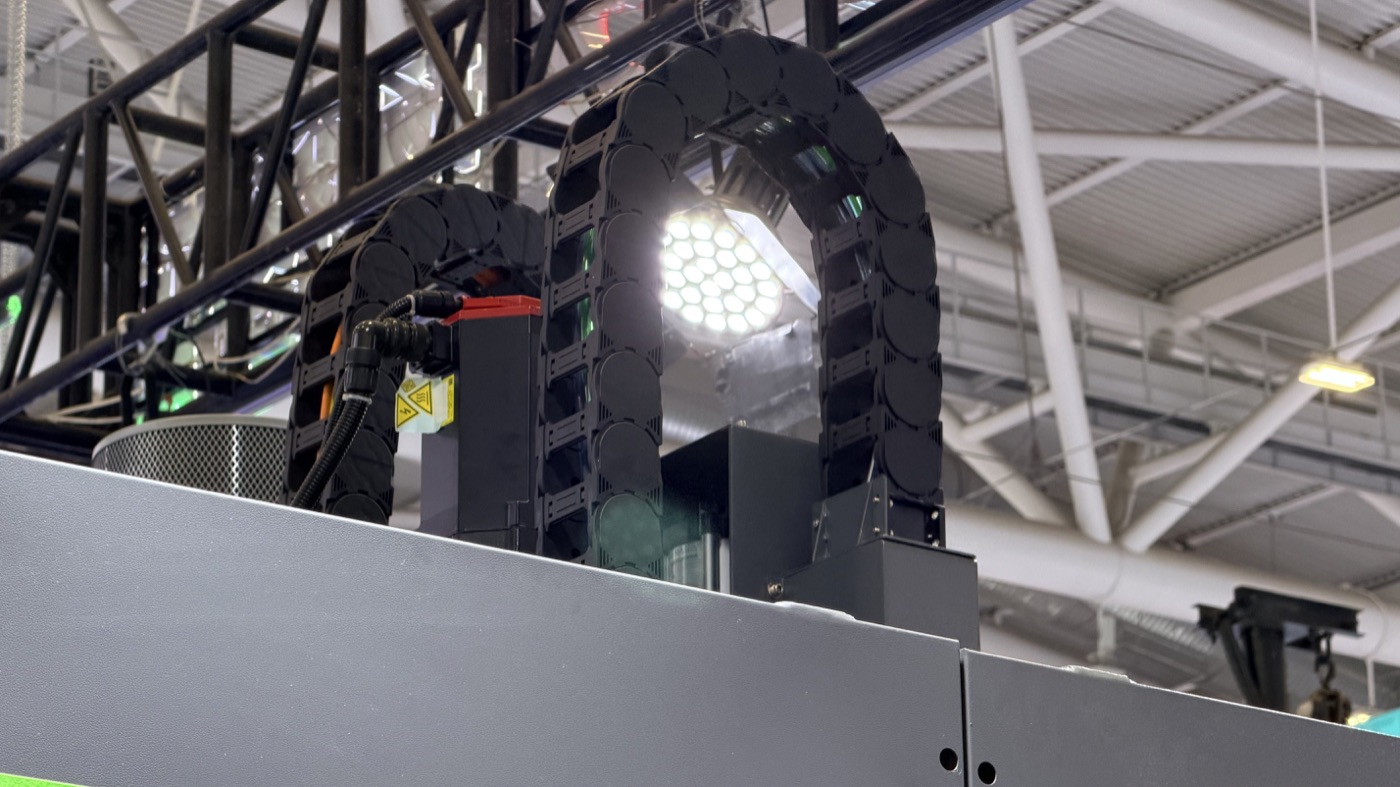
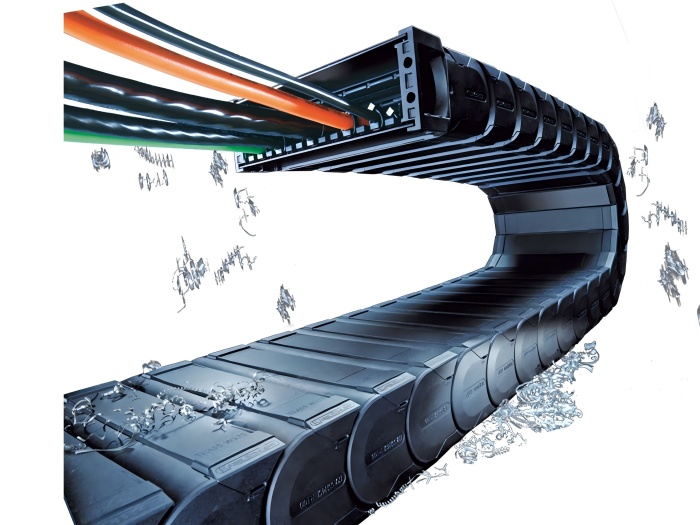
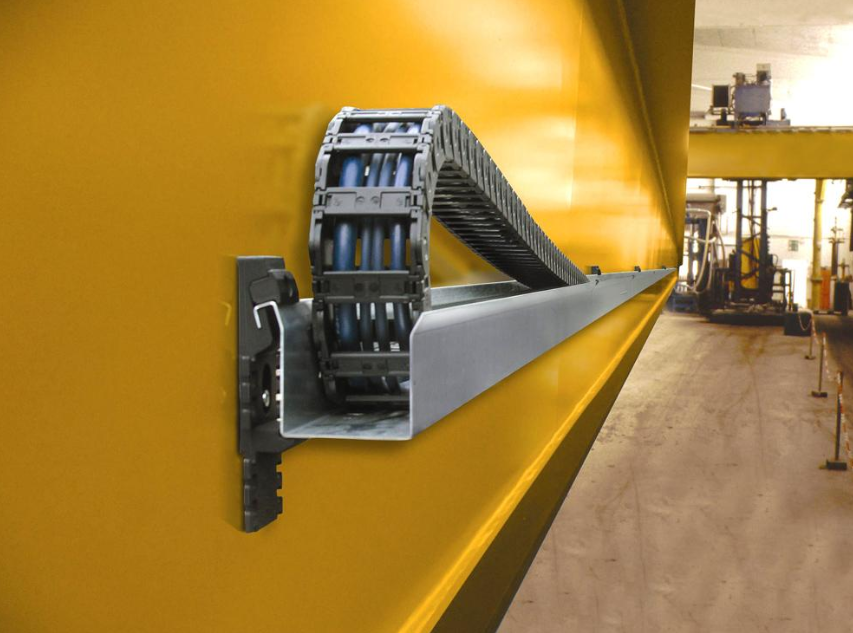
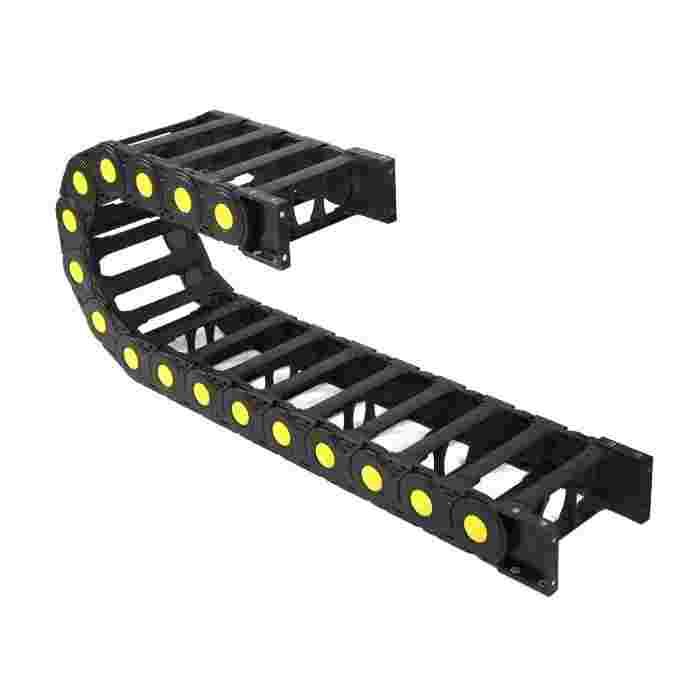
For heavy festoon systems, heavy duty drag chain designs carry the load on the chain rather than the cable, which removes the tensile failure mode described earlier. For installations where noise and vibration are also constraints — ship unloaders and indoor cranes, typically — low noise drag chain series reduce running noise without changing the electrical assessment. Sizing follows the same logic as any drag chain application: establish the required chain size from cable bundle diameter and then confirm the minimum bend radius is respected over the full travel.
Verification checklist before you sign
Use this list against any supplier claiming ATEX or IECEx compliance. It applies to equipment, glands, and complete assemblies — not to the cable itself.
- Ask for the EU-Type Examination Certificate number, not a "certificate of compliance" or a self-declaration
- Identify the Notified Body by its four-digit number and confirm it is notified for that equipment category
- Confirm the certificate is current and check the issue date against the directive version
- Match the model and rating on the certificate to the exact part number being quoted — a family certificate often excludes the variant you are buying
- For IECEx, verify the certificate number in the IECEx online certificate system rather than accepting a PDF
- Request the schedule drawings or conditions of certification, which state the permitted cable types, gland types, and temperature limits
- Confirm the IP rating claimed is the one tested with the gland actually supplied, not the enclosure's rating in isolation
If a supplier cannot produce a certificate number that resolves in the relevant database, treat the claim as unverified regardless of how the datasheet is worded.
Common mistakes worth avoiding
- Buying "ATEX certified cable." No such certificate exists. What you need is a cable that satisfies EN 60079-14 for your zone, plus certified glands and enclosures.
- Using a IIB-rated device in an IIC atmosphere. Gas group is a hard boundary, not a suggestion.
- Running to the temperature class limit. Leave a margin; bundling and ambient conditions erode it.
- Skipping the barrier gland at a zone boundary. Zone carry-over through the cable is a real migration path.
- Assuming a fixed-installation cable rating transfers to festoon duty. Bending cycles and tensile load are separate limits.
- Treating the carrier as outside the assessment. Friction, static, and grounding all live in that component.
Frequently asked
Does a festoon cable need an ATEX certificate?
No. Directive 2014/34/EU applies to equipment and protective systems; cables and wires fall outside its scope, and no type examination is issued for them. Selection and installation follow EN 60079-14.
What does need ATEX or IECEx certification?
Cable glands, junction boxes, enclosures, control panels as complete assemblies, and any device that could act as an ignition source. The gland matters most in practice because it preserves the enclosure's protection concept where the cable enters.
Can I use a standard industrial cable in Zone 2?
Possibly, but only if it meets the EN 60079-14 requirements listed above and your Explosion Protection Document permits it. Zone 2 is the least demanding classification, not an exemption.
How do I know which cable a supplier's gland is certified for?
The certificate's schedule drawings or conditions of certification state the permitted cable construction, armour type, sheath material, and conductor size range. Ask for that document, not just the certificate cover page.

Specifying a chain for a hazardous area?
Send us the zone classification, gas group and cable list. Our engineers reply with the chain and cable combination the standards allow, usually within one working day.
Related technical articles
Cat Track Cable Carrier | Plastic Cat Track System for Overhead Cranes | SONDA: Cheaper, Faster, Smarter Than igus
Heat Resistant Cable Carrier India | SONDA vs igus | Top Cable Drag Chain Brands with Global Flexibility