
Low Noise Drag Chain HXSD-JY
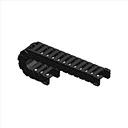
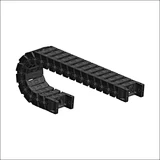
The HXSD-JY range is our quiet-running bridge chain, built for linear drive modules, stages and measurement equipment where vibration shows up in the work rather than in the machine. Four inner heights cover 18 to 45 mm, and every series opens on both sides for cable access without splitting the chain.
Why a drag chain gets loud
Most chain noise is not the plastic rubbing. It is the polygon effect. As the chain rolls around the bend radius, each link pivots by a fixed angle, so the chain's effective length changes in steps rather than continuously. The moving end therefore speeds up and slows down once per link. That periodic speed change is what turns into audible vibration and, on a linear module, into visible ripple in the work.
Two numbers control it: the pitch and the bend radius. A shorter pitch means smaller steps and a higher frequency, which couples less energy into the machine frame. Comparing our 18 mm chains makes the point: the standard HXSD13 runs a 35.2 mm pitch at 29 links per metre, while the quiet HXSD01J runs a 17.6 mm pitch at 57 links per metre. Half the pitch, twice the steps, and the speed ripple amplitude roughly halves with it.
The bend radius matters too, because a larger radius means a smaller pivot angle per link. That is why a quiet chain is usually specified one radius step above the minimum the cable allows, not exactly at it.
HXSD-JY series specifications
| Series | Inner height | Inner width | Bend radius | Pitch | Links per m | Outer height | Max cable diameter | Mounting height | Load capacity |
|---|---|---|---|---|---|---|---|---|---|
| HXSD01J | 18 mm | 25 / 37 / 50 | R28 - R48 | 17.6 mm | 57 | 24.5 mm | Ø16 mm | H + 24.5 | 3 kg/m |
| HXSD02AJ | 25 mm | 25 to 100 (11 widths) | R48 - R150 | 24 mm | 42 | 35 mm | Ø22 mm | H + 34 | 3 kg/m |
| HXSD06J | 35 mm | 38 / 50 / 77 / 100 / 125 | R60 - R150 | 33.6 mm | 29 | 47.8 mm | Ø32 mm | H + 47.8 | on request |
| HXSD10J | 45 mm | 50 / 75 / 100 | R75 - R200 | 33 mm | 29 | 58.1 mm | Ø40 mm | H + 58.1 | 5 kg/m |
All four series are bridge type with side opening on both sides. Material is PA6 with 30 percent glass fibre, black, rated minus 20 to plus 125 degrees Celsius. Where a fully enclosed version is needed, the standard heavy range covers that duty instead.
How the four sizes map to cable bundles
Inner height is set by the cable bundle, not by the chain you used before. The usable rule is that the bundle diameter including any spiral wrap must leave at least 10 percent free space at the top of the inner channel, and cables must be able to move sideways when the chain bends.
- HXSD01J, 18 mm inner height, up to Ø16 mm cable. Small linear modules, pick and place heads, camera axes. Three inner widths only, so check the bundle width before designing around it.
- HXSD02AJ, 25 mm inner height, up to Ø22 mm cable. The widest choice in the range at 11 inner widths from 25 to 100 mm. This is the series to start with when a servo plus encoder plus air line has to share one channel.
- HXSD06J, 35 mm inner height, up to Ø32 mm cable. Larger drives and short travel axes with several hoses. Five inner widths.
- HXSD10J, 45 mm inner height, up to Ø40 mm cable. Three widths, for heavy cable bundles at low to moderate speed.
Width follows the fill rule: total cable cross section should stay at or below 55 percent of the channel cross section, and below 50 percent where the load is dynamic. Above 70 percent fill the cables grind against each other instead of sliding, and wear rises sharply. If the sum of your cables lands at 80 percent of an available width, take the next width up rather than accepting the tight fit.
Bend radius, loop height and the space you actually need
The chain loop needs clear height, and that height is governed by the radius, not by the inner height. For a chain running in a standard horizontal loop, the clear height required is approximately 2R plus the outer height of the chain. For HXSD02AJ at R75, that is 150 mm plus 35 mm, or 185 mm of clear vertical space above the mounting plane. At R150 it becomes 335 mm.
This is the constraint that most often forces a design change. If the machine has 200 mm of clear space and the cable needs R100, the honest answer is that the chain will not fit at that radius, and the fix is a more flexible cable that can run at a smaller radius, not a larger chain. On desktop machines and small gantries this decision comes up constantly.
When a silent chain is the wrong choice
Three cases where the JY range is not the answer, stated plainly so you do not order the wrong part:
- Load above 5 kg per metre. The quiet series is rated 3 to 5 kg/m. At higher loads the correct part is the heavy range, and the HXSD35 family carries 45 kg/m at a 72 mm pitch. A quiet chain overloaded is a chain that fails early, quietly.
- Travel over roughly 10 metres. Long travel needs either a gliding arrangement with wear pads or a steel chain. The HXSD-JY series is for unsupported and short gliding use.
- Heavy shock or reversed loads. A quiet chain trades some stiffness for a shorter pitch. Where the axis reverses hard or the chain takes impact, the standard heavy bridge chain is the more durable choice and the noise difference will not be what you notice.
Typical applications
The JY range is usually specified for clean room equipment, stage and theatre machinery, printing presses, automation and handling modules, machine tools, measuring and inspection equipment, semiconductor production equipment, medical devices and general machinery where the acoustic signature of the machine matters to the end user.
Two practical notes from installation work: anchor both ends of the chain on the same plane, because a chain mounted out of plane will run against one side wall and that contact noise is often mistaken for the chain being loud. And leave the moving end free to travel through its full arc before tightening cable ties, since a bundle tied too early in the stroke pulls the chain sideways at the extremes.
Ordering
The order code carries the series, inner height, inner width, radius and length in links. A 100 mm wide HXSD06J at R75 with 26 links reads HXSD06J-35-100-R75L-N26, supplied with a matched connector set for both the moving and fixed end as one set. Tell us the travel distance and we will return the link count, since the link count is where most first orders go wrong: a chain ordered from the stroke alone usually comes up short by the arc allowance.
Choosing between the four inner heights, and the 40 mm question
18, 25, 35 and 45 mm are the only quiet sizes in the range — there is no 40 mm series. If a drawing specifies 40 mm, the bundle diameter and the clear height decide whether the 35 mm or the 45 mm chain is the honest answer.
- Looking for a 40 mm quiet chain: why it does not exist and what to use instead
- 45 mm quiet chain: HXSD10J sizes, radii and cable range
Related technical articles
Selection guides, installation notes and application cases related to Low Noise Drag Chain HXSD-JY.
- How to Choose a Cable Carrier: 6 Simple Steps for Machine Bu
- How to Choose a Reliable Cable Carrier Manufacturer for Indu
- China Drag Chain – Reliable Solutions from a Trusted Manufac
- Upgrade Your Shapeoko 3 XXL with a Better Drag Chain System
- Best Anet A8 Drag Chain Upgrade for Clean, Stable, and Long-
- Lightweight Plastic Cable Tracks for Flexible Automation
- Innovative Drag Chain STL Models for Custom Cable Systems
- Reliable Conveyor Chains for Textile Packaging
- Trusted Drag Chain Manufacturers in China
- Find the Best Cable Drag Chain Near You
- Top Energy Chain Picks for CNC in 2025
- Cheap Plastic Cable Track for Sale: SONDA vs igus Energy Cha
- Corrosion-Resistant Nylon Drag Chains for Chemical Plants: S
- SONDA vs igus Cable Carriers: Best Drag Chain Solutions with
- SONDA Dynamic Cable Carriers: High-Speed, Multi-Axis Precisi
- Stainless Steel Corrosion Resistant Chains: SONDA vs igus En
- 1
