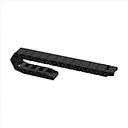
Mini Drag Chain HXSD-MINI
The mini range covers five inner heights from 5 to 18 mm across ten series. It is the part of our catalogue built for axes where the whole machine is smaller than a conventional chain: robot arms, desktop machines, camera gantries, lab equipment and small handling heads. Because the range is dense, most of the work in specifying one is picking the right series rather than finding something that fits.
Ten series across five inner heights
The heights are 5, 7, 10, 15 and 18 mm. Within a single height there are often two or three series that differ only in how the chain opens, which is the specification detail that decides most orders.
| Series | Inner height | Inner width | Bend radius | Pitch | Links per m | Outer height | Max cable diameter | Mounting height | Opening |
|---|---|---|---|---|---|---|---|---|---|
| HXSD01 | 5 mm | 5 mm | R10 | 10.1 mm | 99 | 8 mm | Ø3.5 mm | H + 8 | Closed bridge |
| HXSD02 | 7 mm | 7 mm | R15 - R28 | 17 mm | 59 | 10 mm | Ø3.5 mm | H + 10 | Closed bridge |
| HXSD03B | 10 mm | 11 / 15 / 20 mm | R18 - R48 | 20 mm | 50 | 15 mm | Ø3 to 7.5 mm | H + 15 | Closed bridge |
| HXSD03C | 10 mm | 15 mm | R18 - R38 | 16.7 mm | 59 | 15.6 mm | Ø9 mm | H + 15 | Side opening |
| HXSD07 | 15 mm | 15 to 50 mm (5 widths) | R28 - R48 | 22 or 26 mm | 48 | 20 mm | Ø13 mm | H + 20 | Opens on outer radius |
| HXSD08C | 15 mm | 15 to 50 mm (5 widths) | R28 - R48 | 22 or 26 mm | 39 | 19.4 mm | Ø13 mm | H + 19.4 | Semi-enclosed, side opening |
| HXSD09 | 15 mm | 15 mm | R28 - R48 | 22 mm | 46 | 20 mm | Ø13 mm | H + 20 | Semi-enclosed, closed |
| HXSD11 | 18 mm | 18 / 25 / 37 / 50 mm | R28 - R48 | 35.2 mm | 29 | 23.5 mm | Ø16 mm | H + 24 | Semi-enclosed, side opening |
| HXSD13 | 18 mm | 25 / 37 / 50 mm | R28 - R48 | 35.2 mm | 29 | 23.5 mm | Ø16 mm | H + 23.5 | Opens on outer radius |
| HXSD14F | 18 mm | 25 mm | R28 - R48 | 35.2 mm | 29 | 24 mm | Ø16 mm | H + 24 | Press-open cover |
Material for all ten is PA6 with 30 percent glass fibre, black, rated minus 20 to plus 125 degrees Celsius.
Two series carry a width-dependent pitch: on HXSD07 and HXSD08C the wider versions use a longer pitch, which changes the link count for a given length. If you are matching an existing chain on one of these, send us the width and we will confirm which pitch applies.
Closed, side-opening or press-open
This is the choice that causes the most returns in the mini range, because a closed chain cannot accept a cable that was not planned for.
- Closed (HXSD01, HXSD02, HXSD03B, HXSD09). Nothing opens. The cable must be threaded through from one end before the chain is assembled. Cheapest and stiffest per size, and the right answer when the harness is fixed and known.
- Side opening (HXSD03C, HXSD08C, HXSD11). The cross bar lifts on the side of the bend. Cables can be added or replaced in service without breaking the circuit. Specify this whenever there is any chance the harness will change.
- Outer radius opening (HXSD07, HXSD13). The chain opens on the outside of the bend, so cable access is from the outside of the loop, which is easier to reach on a machine head.
- Press-open cover (HXSD14F). A cover that presses off for access to the whole bundle. Used where access matters more than stiffness.
Which inner height for which bundle
The vertical space sets the cable size, and at mini scale the bundle is usually one or two cables:
- 5 mm (HXSD01) and 7 mm (HXSD02). One cable up to Ø3.5 mm. Sensor leads, single signal pairs, small camera cables. HXSD01 runs a 10.1 mm pitch at 99 links per metre, which makes it smooth but produces a lot of articulation, so cable flex rating matters more here than on any other size.
- 10 mm (HXSD03B, HXSD03C). One or two leads up to Ø7.5 to 9 mm. The 15 mm wide versions take a servo lead plus an encoder pair.
- 15 mm (HXSD07, HXSD08C, HXSD09). Up to Ø13 mm cable, and five widths let you carry two or three leads side by side. This is the most commonly ordered mini height.
- 18 mm (HXSD11, HXSD13, HXSD14F). Up to Ø16 mm, four widths. The step from 15 to 18 mm buys noticeably more room for a bundle that also contains an air line.
Fill allowance still applies: keep the bundle at 55 percent of channel cross section or less, and 50 percent for continuous motion. On a 5 mm chain that means a single cable and nothing else, which is worth knowing before designing a two-cable harness around HXSD01.
Bend radius at mini scale
Radii run from R10 on the smallest up to R48. Clear height above the mounting plane is approximately 2R plus the outer height, which at this scale is genuinely small: 28 mm total at R10, 76 mm at R28, 116 mm at R48.
The constraint to watch is the cable, not the space. A 3.5 mm sensor cable rated at 7.5 times diameter needs R26, which rules out R10 and R15 even though the chain is available at those radii. Chain-rated continuous flex cable in this size range is usually the only cable that will survive R10 at any real cycle count. If a customer asks for the smallest mini chain, the useful question is what cable they intend to run through it.
Where mini chains fail
Three failure modes account for most of the mini returns we see, and none of them are manufacturing defects:
- Cable fatigue at R10 and R15. The chain survives; the cable conductor strands break. Minimum radius on the datasheet refers to the chain, and the cable has its own limit that is usually larger.
- Over-filling a small channel. A 15 mm channel with a 13 mm cable is 87 percent occupied, and the cable has nowhere to slide. Jacket wear follows, then conductor damage.
- Mounting an 18 mm series on a bracket designed for a 15 mm chain. The mounting heights differ, H + 19.4 against H + 23.5, so the chain runs off plane and loads one side wall.
All three are avoided with two numbers: the cable's minimum bend radius at the cycle count, and the mounting height of the series you actually ordered.
Ordering
Series, inner height, inner width, radius and link count. Examples: HXSD03C-10-15-R28L-N20, HXSD11-18-37-R38L-N12. Connectors are supplied as a matched set for both the moving and fixed end. For robot arm applications tell us the axis layout as well as the stroke, because a chain running on a rotating arm has a different length requirement than one running on a linear axis of the same travel.
Related technical articles
Selection guides, installation notes and application cases related to Mini Drag Chain HXSD-MINI.
- Cable Carrier for Machine Tool: The Complete Selection Guide
- Drag Chain Factories: What to Look for When Sourcing Directl
- China Drag Chain Nested – Made in China, Shipped Smarter
- High-Speed Drag Chains for Fast-Motion Industrial Applicatio
- China Nylon Drag Chain: High-Quality, Export-Grade Cable Car
- Durable Plastic Drag Chain Cable Carriers
- Reliable Hose Drag Chain Solutions for Industry
- Anti-Vibration Cable Solutions for High-Speed Conveyors
- Hygienic Conveyor Energy Chains for Food & Beverage
- Essential Cable Chain Accessories for Reliable Performance
- Zinc Alloy End Fitting for Every Drag Chain
- RoHS-Compliant Energy Chains for Electronics: SONDA vs igus
- Modular Wire Cover Systems & Cable Guides: SONDA Outperforms
- Open Frame Drag Chain & Customizable Cable Routing: SONDA vs
- SONDA Two-Axis & Multi-Axis Cable Carriers: High-Flex Drag C
- 1
- 2
