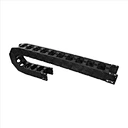
60mm Internal Height Drag Chain
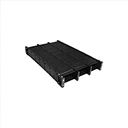
The 60 mm inner height sits at the top of the standard heavy range, below only the 85 mm series. It is the size specified when a machine carries several large hoses plus drive cables and the bundle needs real cross section rather than careful packing. Two series cover it: HXSD41 in bridge form and HXSD42 fully enclosed, both on a 91 mm pitch.
What 60 mm of inner height is for
At this size the chain is carrying hose bundles, not cable bundles. A 55 mm maximum cable or hose diameter means a single large coolant line fits with clearance, and two hoses of 25 to 30 mm plus a pair of servo cables fit side by side in the wider versions.
The reason to choose 60 mm over 45 mm is almost always a hose, not a cable. Cables can be packed tightly and still survive; a pressurised hose changes length under pressure and needs room to move, which is why the fill allowance for hose is lower than for cable. A 45 mm channel that looks adequate by cross section often fails because the hose has nowhere to go when the pressure comes on.
HXSD41 and HXSD42 specifications
| Series | Inner height | Inner width | Bend radius | Pitch | Links per m | Outer height | Max cable diameter | Mounting height | Load capacity |
|---|---|---|---|---|---|---|---|---|---|
| HXSD41 | 60 mm | 75 to 500 (16 widths) | R135 - R350 | 91 mm | 11 | 88 mm | Ø55 mm | H + 88 | 70 kg/m |
| HXSD42 | 60 mm | 75 to 300 (8 widths) | R135 - R350 | 91 mm | 11 | 88 mm | Ø55 mm | H + 88 | 70 kg/m |
An extended-width variant uses the same geometry with longer cross bars, up to the same 500 mm maximum, for applications where the bundle is wide but not tall.
Material is PA6 with 30 percent glass fibre, black, rated minus 20 to plus 125 degrees Celsius. Opening is on both sides on both series.
Bridge or fully enclosed
HXSD41 is the bridge version: open cross bars, so you can see the bundle, reach in, and the chain sheds chips and dust rather than collecting them. HXSD42 is fully enclosed, which is what you specify when the environment throws material at the chain rather than letting it fall away.
The distinction that decides it in practice: a bridge chain in a chip environment eventually packs chips between the cables, and the resulting abrasion cuts jackets. An enclosed chain in a hot environment traps heat around the bundle, and cable jacket life falls with temperature. Neither is universally better. Machining centres with flood coolant take the enclosed version; welding cells, foundry areas and outdoor gantries take the bridge version and accept the cleaning routine.
One more difference: the enclosed version limits the radius range. At this size both series reach R350, but on other heavy sizes the fully enclosed variant starts at a larger minimum radius because the cover needs space to swing. Check the minimum radius on the enclosed series before assuming it matches the bridge version.
Load rating and what it really means
70 kg per metre is the rated cable and hose weight for these series. Two things follow from it that are worth stating plainly.
First, the load rating is a per-metre figure on the moving bundle, not a total machine load. It is calculated on the chain's ability to carry its own weight plus the bundle over the unsupported span without sagging past the point where the chain stops running true.
Second, pin wear scales with the cube of load. Running at 84 kg/m when the chain is rated 70 is not a 20 percent overload in life terms, it is roughly eight times the wear rate. That is why we ask for the real bundle weight including hoses full of fluid rather than an estimate from the drawing.
Where the unsupported span is long, the answer is a support or a gliding arrangement, not a larger chain. A chain specified two sizes up to fix a sag problem carries more weight, sags more, and solves nothing.
Bend radius and clear height
Seven radii from R135 to R350. Clear height above the mounting plane is approximately 2R plus 88 mm, so 358 mm at the minimum R135 and 788 mm at R350. That is a large envelope, and it is the number that most often rules this size out of an existing machine: a 60 mm chain at R200 needs 488 mm of clear height, which many machine frames do not have.
The radius itself is set by the stiffest item in the bundle. In a machine tool that is usually the servo or feedback cable, not the coolant hose, because hose is more flexible than people assume and chain-rated cable is less flexible than its datasheet suggests at low temperature. Confirm the radius against the cable manufacturer's chain rating, and if the available height only allows a smaller radius than the cable wants, the answer is a more flexible cable rather than a shorter chain life.
Ordering
Order code: series, inner height, inner width, radius, link count, for example HXSD41-60-150-R200L-N6. Connectors are supplied as a matched set for moving and fixed end. For this size we normally ask for the stroke, the clear height available and the bundle weight, because those three numbers determine whether a 60 mm chain can be fitted at all, and it is cheaper to establish that before a quotation than after.
Related technical articles
Selection guides, installation notes and application cases related to 60mm Internal Height.
- China Bridge Drag Chain Manufacturer: Heavy-Duty Cable Solut
- Heavy Duty Hinged Drag Chains
- 5 Inch Cable Drag Chain: Reliable Solutions for Your Machine
- Dustproof Drag Chain Solutions for Woodworking and Harsh Env
- AI-Driven Wire Management with Energy Chains
- Tsubaki Cable Chains: Comparing Material Performance
- Affordable Drag Chain Cables for Reliable Performance
- Smart Textile Automation Cable Chains
- Smarter Cable Solutions for Industrial Automation
- Crocodile Cable Carriers for Smart Automation
- Durable Energy Chains for Precision Industries
- Complete Drag Chain Accessories: Shengda vs igus - Better Va
- Plastic Cable Drag Chains for Automation: SONDA’s Nylon Non-
- Dynamic Cable Wire Routing & EV Battery Assembly Solutions:
- Dynamic Cable Protection Solutions: Streamline Automation wi
- Drag Chain for Sale at Lowest Price
- drag chain size calculation guide
- 1
