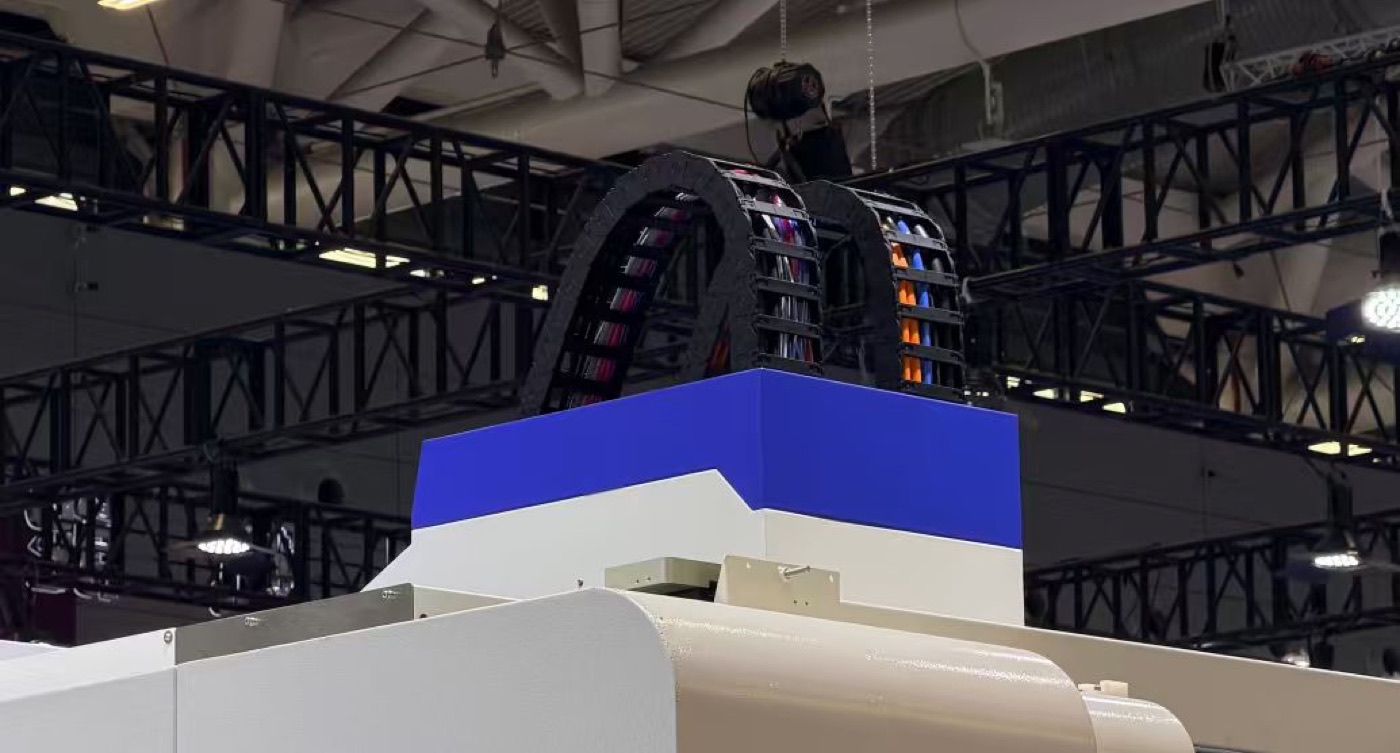
Plastic Drag Chain Series for Machine Tools: Material and Selection
Why Most Machine Tools Run a Plastic Carrier
Steel carriers still exist and still make sense on cranes, on hot plant and on very long unsupported runs. But the majority of machine tool axes now run a plastic chain, and the reasons are practical rather than fashionable.
- Mass. A polyamide chain weighs roughly one seventh of a steel chain of the same cavity. On a high-acceleration axis that difference goes straight into the servo sizing.
- No lubrication. Polyamide against polyamide runs dry with a low friction coefficient. A steel chain needs grease, and grease plus chips makes an abrasive paste.
- Noise. A plastic chain on a plastic trough is several decibels quieter, which matters on a machine with an operator standing beside it.
- Cost. Injection moulding makes a repeatable link at a fraction of the cost of a machined or stamped steel one.
- Damage behaviour. When a plastic link fails it usually cracks and drops; a steel link can bend into the cable bundle and cut through several cables at once.
The trade-off is temperature, load and chemical resistance. Those three are where the selection is actually decided, and where two chains that look identical in a catalogue can behave completely differently.
The Polymer Behind the Link
Almost every plastic carrier is moulded from a polyamide, but the grade decides the application more than the geometry does. Four grades cover the machine tool market.
| Grade | Continuous temperature | Typical use | Limitation |
|---|---|---|---|
| PA6 unfilled | −20 to +80 °C | Light axes, woodworking, small routers | Absorbs moisture, softens when warm |
| PA6 / PA66 + 20–30 % glass fibre | −30 to +100 °C | Standard machine tool axes | More brittle at low temperature |
| PA with heat stabiliser, GF | −20 to +120 °C | Near motors, spindles, foundry | Shorter life at the top of the range |
| PPS or PPE blend | −40 to +150 °C | EDM, hot processes, aggressive coolant | Two to three times the cost |
Glass fibre is what gives a link its stiffness and its unsupported length. A 25 mm cavity in unfilled PA6 and the same cavity in 30 % GF PA66 are not interchangeable: the reinforced link carries roughly twice the load before it deflects past its design limit.
Water Absorption and Dimensional Change
Polyamide absorbs water. This is the single most misunderstood property of a plastic carrier, and it explains most of the odd field reports.
Unfilled PA6 can take up 2.5 to 3 % of its own weight in moisture at 50 % relative humidity, and more when immersed. A link that measures 40.0 mm when moulded can measure 40.4 to 40.6 mm after a season in a humid workshop. That is enough to tighten the joint, increase the pull force and, in the worst case, make the chain run stiff at the reversal.
- Glass-fibre reinforced grades absorb roughly half as much as unfilled, which is one more reason they dominate machine tool applications.
- Water-glycol coolant and wash-down expose the chain to far more moisture than humidity alone. Check the joint clearance after a month in service, not on the bench.
- A chain that runs stiff after a few weeks is often not worn, it is swollen. Do not add lubricant; check the grade and the clearance.
- PPS absorbs almost nothing and holds its dimensions in wet processes, which is why it is specified on EDM and food equipment.
Chemical Resistance in Practice
Machine tools expose a carrier to a mix of fluids that no single data sheet covers. The useful question is not "is polyamide resistant to coolant" but "which coolant, at what concentration, at what temperature".
| Medium | Standard PA | GF PA | PPS | Note |
|---|---|---|---|---|
| Mineral cutting oil | Good | Good | Good | Watch swelling over years |
| Water-miscible coolant | Good | Good | Very good | Concentration matters more than chemistry |
| Water-glycol (HFC) | Fair | Fair | Very good | Highest moisture uptake of the common fluids |
| Neat cutting oil with EP additives | Fair | Good | Very good | Additives attack unfilled grades |
| Diesel or kerosene wash | Fair | Fair | Good | Degreasing removes nothing from PA but softens it |
| Strong alkaline cleaner | Poor | Fair | Good | Caustic attacks polyamide hydrolysis-style |
| Chlorinated or ozone water | Poor | Poor | Good | Common in some food and medical machine tools |
| UV / direct sunlight | Poor | Fair with stabiliser | Good | Outdoor gantries need a stabilised grade |
If the machine is washed with a strong alkaline foam cleaner once a week, that single fact can eliminate standard polyamide from the specification regardless of load. Ask for the cleaner's datasheet before choosing the grade.
Self-Lubrication and Dry Running
The self-lubricating property of polyamide is what allows a carrier to run millions of cycles without maintenance, but it has two conditions.
- The joint must be dry. Oil and grease attract chips and turn into lapping paste. A carrier that has been greased "to be safe" usually wears faster, not slower.
- The pin surface must be smooth and non-porous. A moulded pin with flash or a porous surface abrades the bore instead of sliding in it.
Where a carrier must run in a dirty environment, the answer is a self-clearing joint geometry, not lubrication. Open the joint, let the debris fall through, and keep the pin dry.
Load Capacity and Unsupported Length
Plastic chains are strong in tension and comparatively weak in bending stiffness. That single sentence explains most application limits.
- Unsupported length is limited by the link's bending stiffness, not by its tensile strength. A 35 mm cavity GF chain typically spans 1.4 to 1.8 m unsupported; the same chain in unfilled PA6 spans noticeably less.
- Additional load is carried by adding support, not by choosing a bigger pin. A glide strip under the lower run doubles the practical span for a fraction of the cost of the next size up.
- Vertical hanging length is limited by the tensile strength of the link and the bracket. Above roughly 3 m of hanging chain, a take-up or counterweight is the correct answer.
- Speed is limited by wear at the joint rather than by strength; a plastic chain at 2 m/s in a clean environment is normal, at 5 m/s it needs a specific high-speed series.
Failure Modes: What Actually Breaks
Plastic carriers fail in a small number of recognisable ways, and the pattern tells you which specification item was wrong.
- Crack at the pin boss. Fatigue from cycles at a temperature above the grade's rating, or a chain that was loaded beyond its unsupported limit.
- Broken side plate at the bracket. Usually a misaligned bracket, or a bundle clamped at one end only so the chain takes the cable weight.
- Polished bore, oval hole. Abrasive dust in the joint, typically from a machine without a shield over the chain.
- Chalky, brittle surface. UV degradation on an outdoor or brightly lit installation.
- Soft, swollen link. Moisture or coolant absorption, usually an unfilled grade in a wet process.
- Melted or deformed link. Radiant heat from a motor, a lamp or a hot chip, not ambient temperature.
Plastic or Steel: A Decision Table
| Condition | Plastic | Steel |
|---|---|---|
| Normal machine tool axis, coolant spray | Preferred | Acceptable but heavier |
| Ambient above 120 °C continuously | Special grade only | Preferred |
| Unsupported span above 3 m | Not recommended | Preferred |
| High acceleration, low moving mass | Preferred | Needs a bigger drive |
| Strong alkaline or chlorinated wash | PPS only | Preferred |
| Hot chips falling on the chain | Needs a shield | Preferred |
| Food or medical washdown | PPS or special PA | Stainless only |
| Cost-sensitive short-stroke axis | Preferred | Rarely justified |
What to Send With an Enquiry
- Stroke, orientation and cycle rate of the axis.
- Cable and hose list with outside diameters and weight per metre.
- Required bend radius, driven by the stiffest cable.
- Ambient and radiant temperature at the chain, not in the workshop.
- Coolant type and concentration, and the wash-down chemical if any.
- Whether the chain runs in a trough, on a glide strip or unsupported.
- Any cleaning regime, including frequency and chemistry.
Those seven items decide the polymer grade, the fibre content, the joint design and the cavity size. Answering them costs ten minutes; guessing at them costs a chain replacement and an unplanned stop.
Comparing plastic drag chain series for a machine tool?
Send us the stroke, the cable and hose list with diameters, the weight per metre and the bend radius you need. Our engineers reply with the chain system — series, inner height and width, dividers, strain relief and a guide trough if required — usually within one working day.
Twin Cable Carriers on One Axis: Layout, Balance and Cable Split
Cable Carrier on an Inclined Axis: Gravity, Troughs and Push Force
Related Article