Cable Carrier on an Inclined Axis: Gravity, Troughs and Push Force
Where Inclined Axes Turn Up on Machine Tools
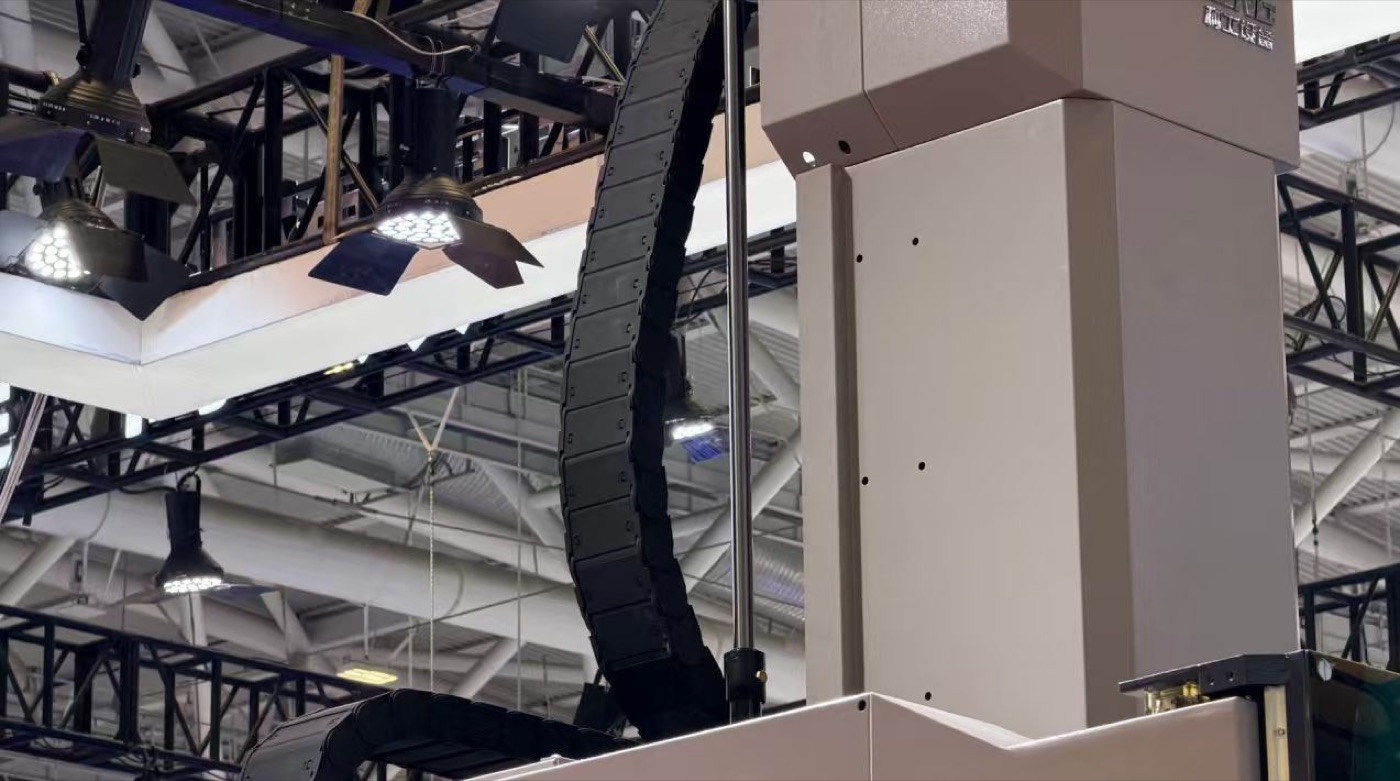
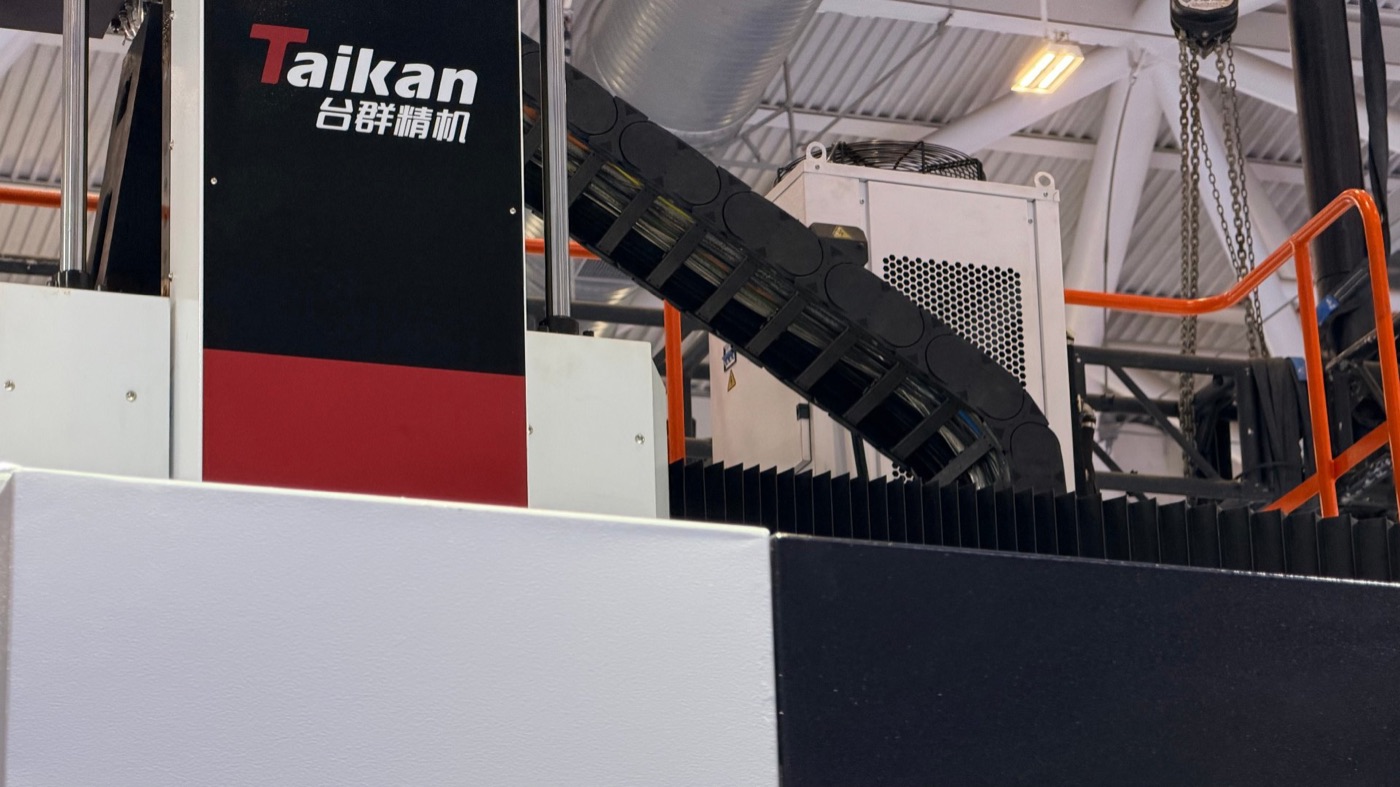
An inclined axis is any axis whose direction of travel is neither horizontal nor vertical. It appears more often than most machine builders expect: the sloping gantry of a stone or bridge saw, the tilting head of a five-axis machine, the inclined Z of a pipe or profile processing centre, the ramp of a chip conveyor, the slanted tool magazine of a drilling centre, and the angled loading arm on a pallet changer.
All of these share one property that changes the whole specification: part of the chain's weight now acts along the direction of travel. On a horizontal axis gravity is perpendicular to motion and the chain only has to be carried. On a vertical axis gravity acts fully along the motion and the chain hangs. On an incline the two effects mix, and the ratio changes with every degree of tilt.
Gravity Changes the Load Path
For an axis inclined at angle a from horizontal, the component of chain and bundle weight acting along the axis is proportional to sin a, and the component pressing the chain onto its support is proportional to cos a.
- At 15 degrees, only 26 % of the weight pulls along the axis, but 97 % still presses down on the trough. The chain behaves almost like a horizontal one.
- At 45 degrees, 71 % pulls along the axis and 71 % presses down. Both effects are significant, and this is the most demanding range.
- At 70 degrees, 94 % pulls along the axis and only 34 % presses down. The chain starts to behave like a vertical one, and the risk shifts from sag to sliding.
The practical rule is that an inclined axis below about 30 degrees can usually be treated as horizontal, and above about 60 degrees as vertical. Between 30 and 60 degrees it needs its own analysis, because neither the horizontal nor the vertical recipe is safe.
What Changes at Each Angle
| Incline from horizontal | Behaviour | Support requirement | Check first |
|---|---|---|---|
| 0 – 15 degrees | Essentially horizontal | Glide strip or plain trough | Sag and drainage |
| 15 – 30 degrees | Slight downhill pull | Trough with side guidance | Chain creeping downhill over time |
| 30 – 45 degrees | Mixed load, worst range | Closed trough, preloaded chain | Push force and buckling |
| 45 – 60 degrees | Mostly along the axis | Closed trough plus clamps at both ends | Bundle sliding inside the chain |
| 60 – 90 degrees | Effectively vertical | Vertical arrangement, take-up or counterweight | Top link load and clamp strength |
Do not accept a supplier's horizontal rating for an axis at 40 degrees without asking what changes. The chain series may be the same; the trough, the clamping and the bend radius usually are not.
Troughs on a Slope: Guidance, Not Just Support
On an incline the trough does two jobs that a horizontal trough does not: it carries the chain, and it stops the chain from walking downhill.
- Side guidance is mandatory above about 20 degrees. An open channel lets the chain drift sideways at each reversal and eventually climb out.
- Preload the chain slightly against the trough floor. A chain that is just resting will creep downhill a few millimetres per thousand cycles, and over a year that is enough to foul the end bracket.
- Drain the trough at the low end. Coolant and wash water run downhill and pool at the bottom bracket, which is exactly where the clamp and the cable entry sit.
- Use a low-friction liner on the floor. On an incline the chain slides as well as rolls, and the friction of bare steel adds to the push force the axis has to deliver.
- Leave the top end open. A fully closed trough traps air and fluid at the high end and makes inspection impossible.
Push Force and Buckling
A cable carrier is a push-pull device: the moving end pushes the chain ahead of it on one stroke and pulls it on the other. On an incline, the downhill stroke works with gravity and the uphill stroke works against it.
Two limits apply to the uphill stroke. The first is the available force from the axis drive, which is rarely the problem. The second is buckling: if the chain is pushed and the far end is restrained, the run can bow sideways or lift out of the trough. Buckling load falls sharply with unsupported length, which is why a long inclined run needs support on both legs, not just under the lower one.
- Check the manufacturer's maximum push force for the series, not the tensile strength. They are different numbers and only one of them governs.
- Keep the chain straight in plan view. A slight curve in the trough reduces the buckling load dramatically.
- Reduce the number of cables and hoses on the inclined axis if the push force is marginal; weight is what the chain has to push uphill.
- On very steep inclines, a counterweight or a spring take-up removes most of the uphill load from the chain.
Anchoring and the Centre of Gravity
The fixed end of an inclined chain should be at the bottom, not the top, for two reasons: the moving mass is then lower, and any fluid that enters the chain drains away from the cables instead of into them.
- Anchor at the low end and let the chain loop upward. The upper bracket then only guides, it does not carry the hanging weight.
- If the geometry forces the fixed end to the top, use a clamp block that carries the full bundle weight and a strain relief that takes the load off the conductors.
- Keep the bundle centred across the chain width. On a slope, an off-centre bundle produces a torsional load that shows up as one side plate wearing faster.
- Leave a service loop at both ends so the chain can be disconnected without cutting cables.
Cables on an Inclined Run
The cable rules are the same as on a horizontal axis, with two additions that come directly from gravity.
| Issue | What to do | Why the incline matters |
|---|---|---|
| Bundle sliding | Clamp individually at the low end; the high end can be a loose guide | Every cable slides downhill unless restrained |
| Jacket abrasion | Use separators and avoid cable-on-cable contact | On a slope the bundle settles and presses cables together |
| Fluid tracking | Drip loop at the low end before the entry gland | Coolant follows the cable downhill into the cabinet |
| Bend radius | Recheck at the lower bend, which sees the tightest geometry | The loop at the low end is often the smallest radius on the machine |
Wear Asymmetry: The Sign the Axis Is Inclined
An inclined chain wears unevenly, and the pattern tells you what is happening.
- Polished strip on one side plate only. The chain is being pushed sideways, usually by trough misalignment or by a bundle that is not centred.
- Wear concentrated at the lower bend. The chain is carrying more load at that end than the design assumed, usually because the fixed point is at the top.
- Even wear but fast. The chain is sliding rather than rolling, which points to a missing or worn liner in the trough.
- Elongation faster than on horizontal axes. The joints are working against gravity on every cycle; accept a shorter inspection interval.
Holding, Braking and Power Loss
On steep inclines the axis may need to hold position with the drive disabled, and the carrier contributes to that load.
- Include the chain and bundle weight component in the holding brake calculation. It is small compared with the machine mass but not negligible on a light tilting head.
- If the axis can lose power while inclined, check that the chain cannot run downhill on its own. A chain with a low-friction liner and a steep trough can creep.
- Add a mechanical stop at the low end of the trough so a runaway chain is caught before it reaches the bracket.
Installation on a Slope
- Mount the trough first and check its straightness in both planes; a twist shows up as side wear later.
- Set the low-end bracket, then run the chain up the trough by hand over the full travel before connecting cables.
- Confirm the chain does not lift out of the trough at any point of the stroke.
- Install cables from the heaviest to the lightest and clamp each at the low end as it goes in.
- Run ten cycles and check for downhill creep by marking the chain against the trough.
- Check drainage with the coolant on, not dry.
Checklist for an Inclined Axis
- Angle of the axis from horizontal, in degrees, at both extremes of any tilt range.
- Travel length and cycle rate.
- Bundle weight per metre and the heaviest single cable or hose.
- Chain series, push force rating and maximum unsupported length.
- Trough type, side guidance and liner material.
- Which end is fixed, and whether fluid can reach the clamp.
- Holding brake data and whether the axis can lose power while inclined.
With those seven the incline stops being a detail and becomes a design input: the angle fixes the support type, the weight fixes the push force, and the fixed end fixes the clamping.
Installing a cable carrier on an inclined axis?
Send us the mounting position, stroke, cable weight per metre, travel speed and the support or guide trough you can provide. Our engineers reply with the series, bend radius and fixing layout, usually within one working day.
Plastic Drag Chain Series for Machine Tools: Material and Selection
Overhead Cable Carrier on a Gantry: Support, Sag and Safety
Related Article