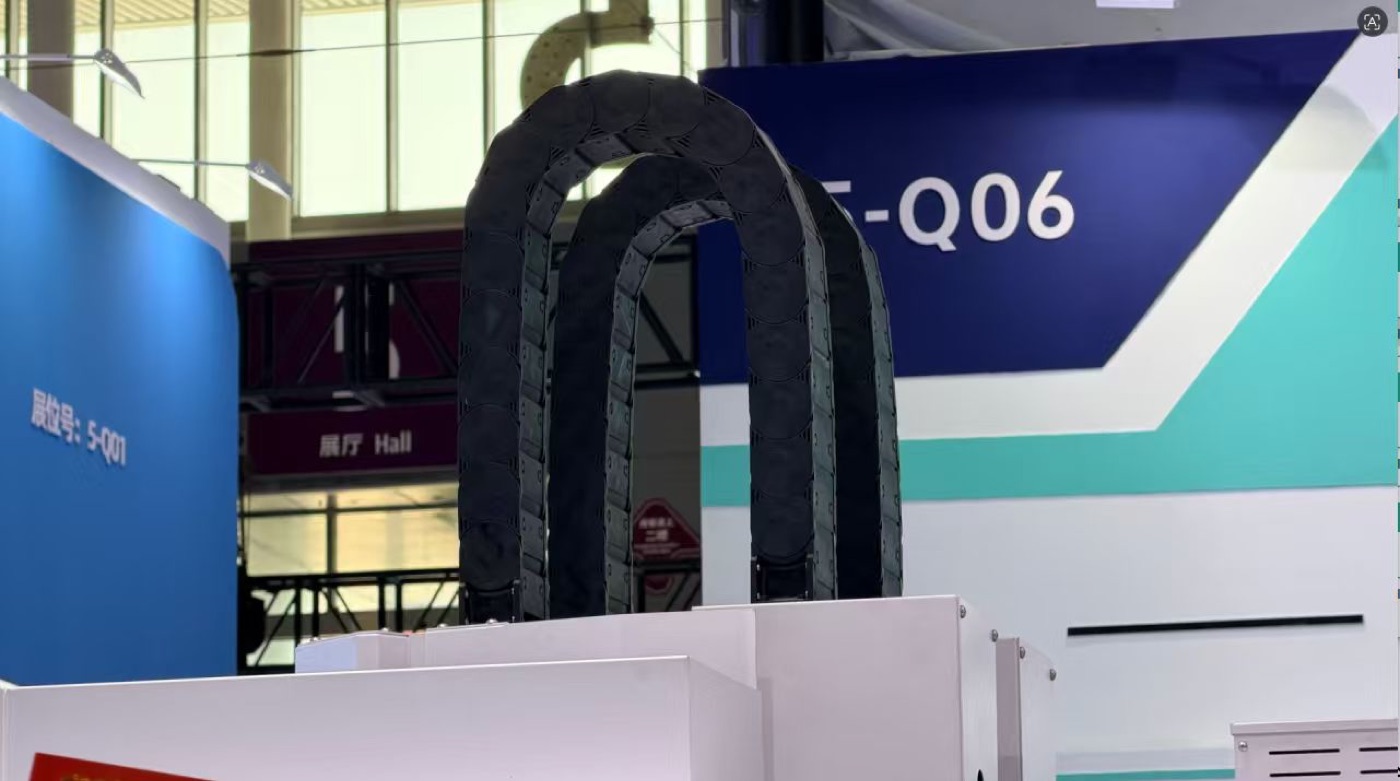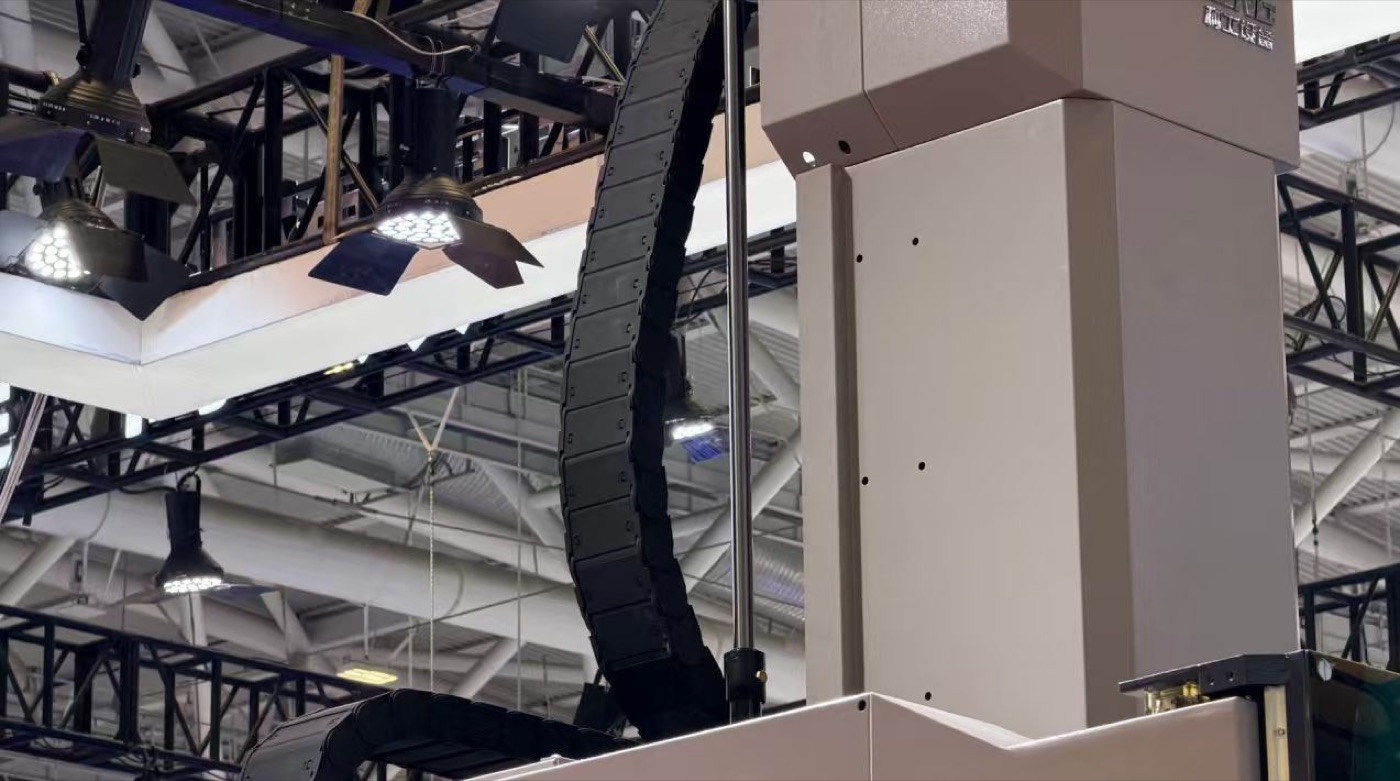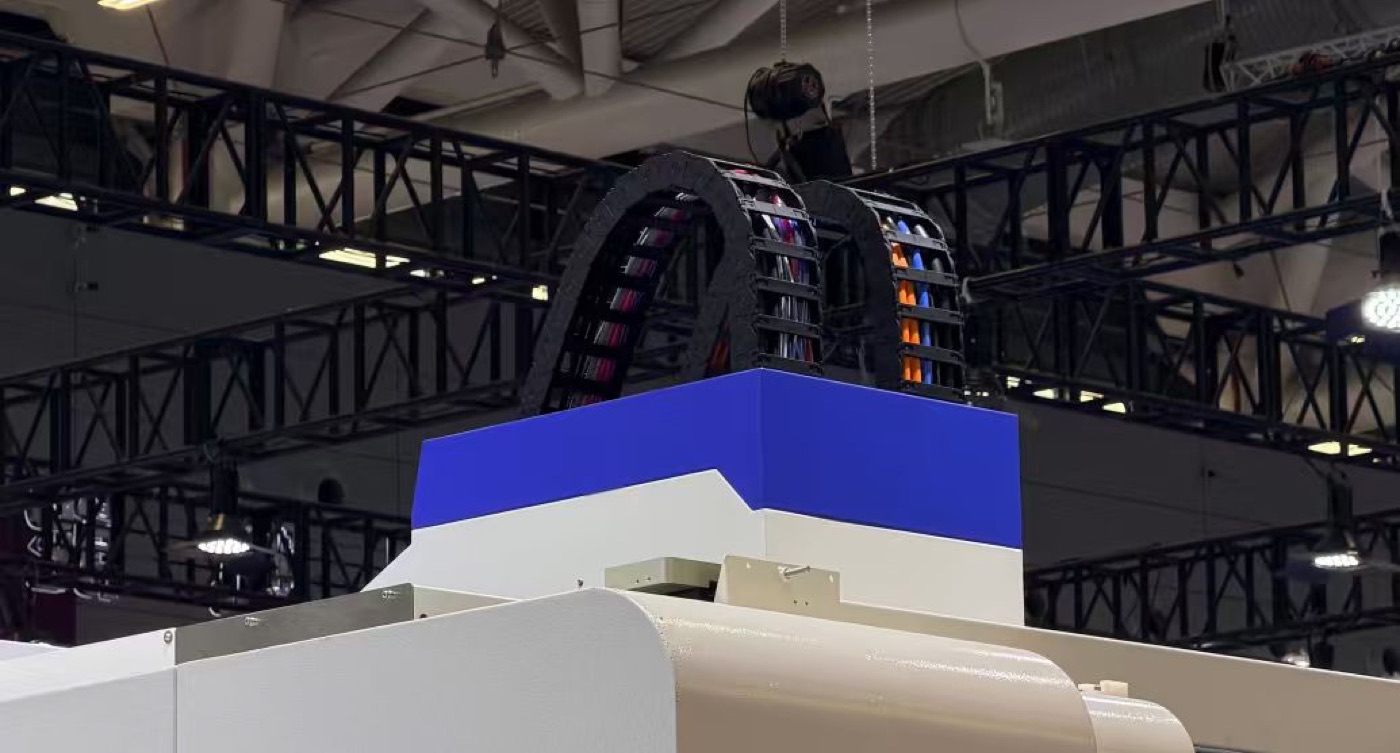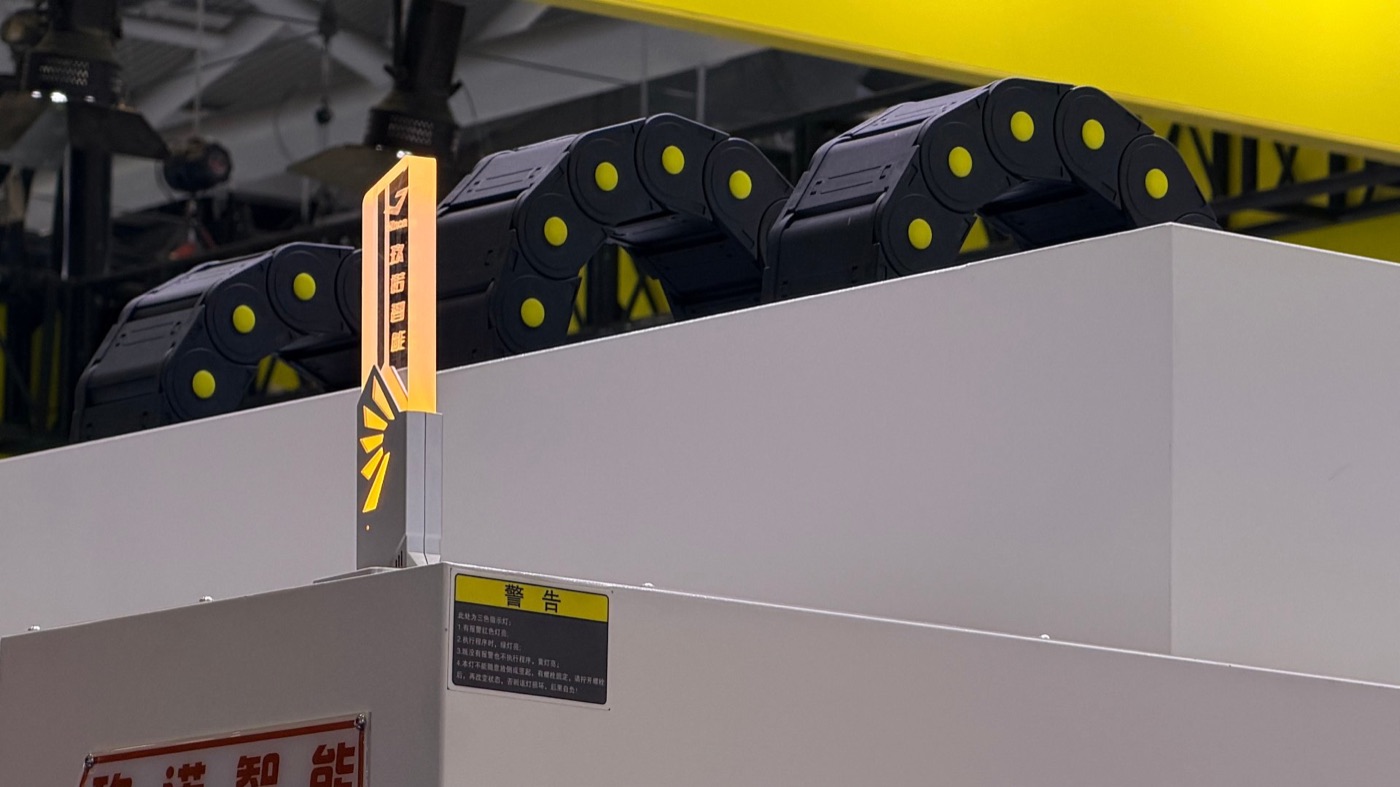
Overhead Cable Carrier on a Gantry: Support, Sag and Safety
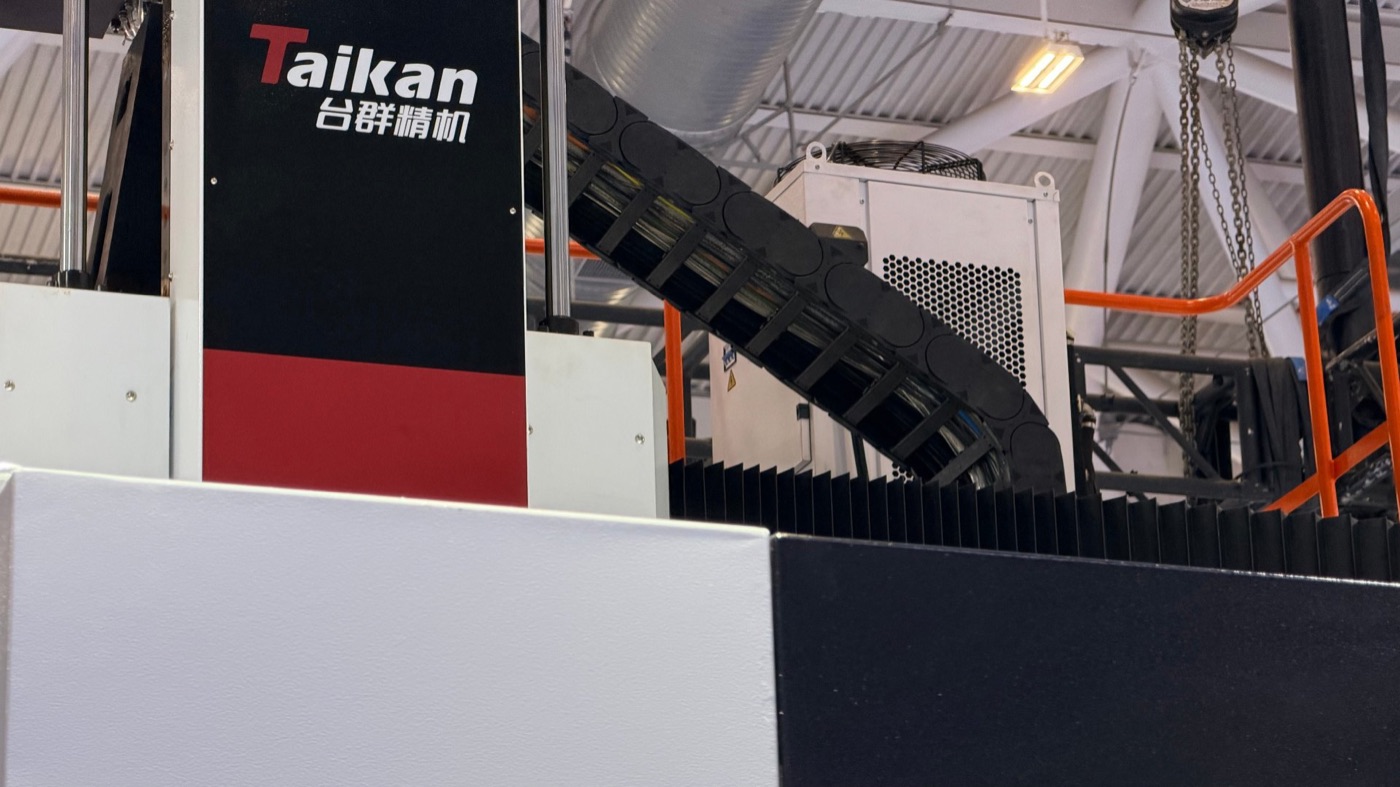
Why an Overhead Run Is Often the Better Layout
On a gantry machine with a long travel, the obvious place for the cable carrier is a trough alongside the rail. It is also the place where it collects chips, coolant and swarf, where it blocks access to the linear guides, and where it forces the machine footprint wider by the length of the chain. Moving the run overhead solves all three, at the price of two new problems: the chain now hangs in the air with nothing under it, and a failure drops down onto the machine instead of sideways onto the floor.
Overhead is the right answer for most large gantry routers, plasma and waterjet tables, and gantry loaders. It is the wrong answer when the machine has no structure above the travel to mount to, or when the headroom is too low for the chain to form its loop. This guide covers the numbers and details that make the difference.
What the Overhead Run Actually Carries
An unsupported chain carries its own weight plus the bundle, and both are cantilevered from the fixed end. Two loads matter.
- Static sag. The chain plus cables hanging between two supports deflects under its own weight. If sag exceeds roughly 1/50 of the support spacing, the links start to ride on each other and the chain runs roughly.
- Dynamic whip. At each reversal the chain is accelerated, and the unsupported span behaves like a string. Long spans with light chains oscillate, and the oscillation is what breaks links and cable strands.
The practical consequence is that an overhead run is designed around support spacing, not around chain strength. A heavier, stiffer chain with wide side plates is usually better overhead than a lightweight chain, because it sags less and oscillates less at the same span.
Support Spacing by Chain Size
The table below gives starting values for a horizontal unsupported run with a typical cable load. Reduce the spacing by 20 % if the chain carries hoses under pressure or a heavy spindle cable.
| Chain inner height | Typical bundle weight | Maximum support spacing | Preferred spacing |
|---|---|---|---|
| 25 mm | 2 – 4 kg/m | 1.0 m | 0.7 – 0.8 m |
| 35 mm | 4 – 7 kg/m | 1.4 m | 1.0 – 1.2 m |
| 45 mm | 6 – 10 kg/m | 1.8 m | 1.3 – 1.5 m |
| 55 mm | 9 – 14 kg/m | 2.2 m | 1.6 – 1.8 m |
| 75 mm and above | 14 – 25 kg/m | 2.6 m | 1.9 – 2.2 m |
These are for a chain that runs on a glide strip. A chain running free in air with no strip should be supported at half the spacing in the table, or not run overhead at all.
Glide Strips: The Detail That Decides Life
An overhead run almost always needs a glide strip under the lower leg. Without it the chain hangs, links rub on each other at the bend, and the run is noisy and short-lived.
- Material. Ultra-high molecular weight polyethylene is the usual choice; stainless strip is used where the chain runs hot or where spark and slag are present.
- Width. The strip should be at least as wide as the chain and ideally capture the side plates so the chain cannot walk off.
- Thickness. 3 to 5 mm for a polymer strip; replace when wear reaches half the thickness, not when it fails.
- Joints. Butt the strip sections tightly and countersink the screws. A 1 mm step at a joint is enough to make the chain jump at every pass.
- Drainage. In wet or dusty plants, leave gaps or drill the strip so fluid and debris do not build up under the chain.
If the machine has to run without a strip, use a series designed for unsupported horizontal runs, and check the manufacturer's maximum unsupported length against your actual bundle weight rather than the catalogue example.
Aligning the Two Rails
An overhead run has a fixed rail and a moving carriage, and the chain has to travel between them without being pulled sideways. Misalignment here is the most common cause of a chain climbing out of its guide or wearing one side plate faster than the other.
- Set the two rails parallel to within 0.5 mm over the full travel, measured along the chain centreline.
- Set the height difference between the rails to within 1 mm. A height error tilts the chain and loads one side of every joint.
- Check alignment at both ends of the travel, not only in the middle. Gantry structures deflect under their own weight, and the rail that is straight at mid-stroke may not be straight at the ends.
- Use slotted brackets so the final adjustment can be made with the chain in place, under load.
The Return Run and the Loop
Overhead installations usually run the chain in a single loop above the gantry, with the fixed end at one end of the travel and the moving end on the carriage. Two geometry points matter.
- The loop must have room to form. As a rule the chain needs a clear height of at least twice the bend radius plus the chain height, and a horizontal clearance of the loop length.
- Keep the loop away from the operator's walkway and from any crane or hoist path. A chain that is hit once by a lifting sling will be replaced.
- If the travel is longer than the chain can span in one loop, a festoon or a two-stage system is the answer, not a longer single chain with more sag.
Access, Safety and Dropped Objects
Overhead hardware fails downward. That single fact drives the safety requirements.
- Fit a secondary retention to every bracket, typically a stainless wire or a captive bolt, so a single fastener failure does not drop the chain.
- Use nyloc nuts or thread-locking compound on all overhead fasteners; vibration loosens plain nuts over months.
- Where the chain passes over an operator position, fit a catch tray or a mesh screen under the run.
- Provide a safe access route for inspection. If a technician needs a ladder to look at the chain, inspection will not happen.
- Mark the chain at the fixed end at commissioning so wear and length growth can be measured later.
Cables for a Long Overhead Run
Overhead runs are longer than trough runs, and length has two effects: more weight in the chain, and more voltage drop in the cable.
| Issue | What to do | Why it matters overhead |
|---|---|---|
| Bundle weight | Move the spindle cable and heavy hoses to a separate lower run | Weight is what causes sag and oscillation |
| Voltage drop | Increase conductor size for runs over 20 m | Long travel plus small conductors equals servo faults at the far end |
| Bend radius | Recheck every cable against the new chain radius | Overhead geometry often forces a tighter loop than a trough |
| Strain relief | Clamp at both ends, never at one | A long hanging bundle pulls on the top clamp with real force |
Environment Above the Machine
The space above a machine is not the same environment as the space beside it. It is hotter, dustier, and often outside the enclosure.
- Temperature above a machine tool can be 10 to 15 °C higher than at floor level; check the link material rating against that, not against ambient.
- Fine dust settles on top of an overhead chain and works into the joints from above. An open-bottom link design lets it fall through.
- Outdoor gantries see UV and rain. Standard polyamide links chalk and embrittle under UV; specify a UV-stabilised grade or fit a cover.
- Plasma and laser gantries see sparks and slag. Keep the chain above the plume and fit a metal shield.
Installation Sequence
- Mount the fixed rail and the glide strip first, and check straightness over the full length with a wire or laser.
- Mount the carriage bracket with the chain at mid-travel, not at the end, so the loop has room.
- Lay the chain in the strip and pull it through by hand over the full travel before connecting any cable.
- Install cables from the heaviest to the lightest, clamping each at both ends as it goes in.
- Run ten full cycles and re-check rail alignment, strip wear marks and clamp torque.
- Record the chain length and mark the fixed end.
Checklist for an Overhead Run
- Total travel, and the height available above the gantry for the loop.
- Bundle weight per metre and the heaviest single cable or hose.
- Chain inner height and the bend radius required by the stiffest cable.
- Support spacing and whether a glide strip is included.
- Rail alignment tolerance achievable on the actual structure.
- Environment: temperature above the machine, dust, sparks, UV or rain.
- Access for inspection and the retention method for every overhead fastener.
Answer these seven and the overhead layout becomes a calculation rather than a guess: spacing follows from weight, loop height follows from radius, and the strip and retention details follow from the environment.
Running a cable carrier overhead on a gantry?
Send us the mounting position, stroke, cable weight per metre, travel speed and the support or guide trough you can provide. Our engineers reply with the series, bend radius and fixing layout, usually within one working day.
Cable Carrier on an Inclined Axis: Gravity, Troughs and Push Force
Cable Carrier for EDM and Wire-Cut Machines: Oil, Water and Sludge
Related Article