Cable Carrier for EDM and Wire-Cut Machines: Oil, Water and Sludge
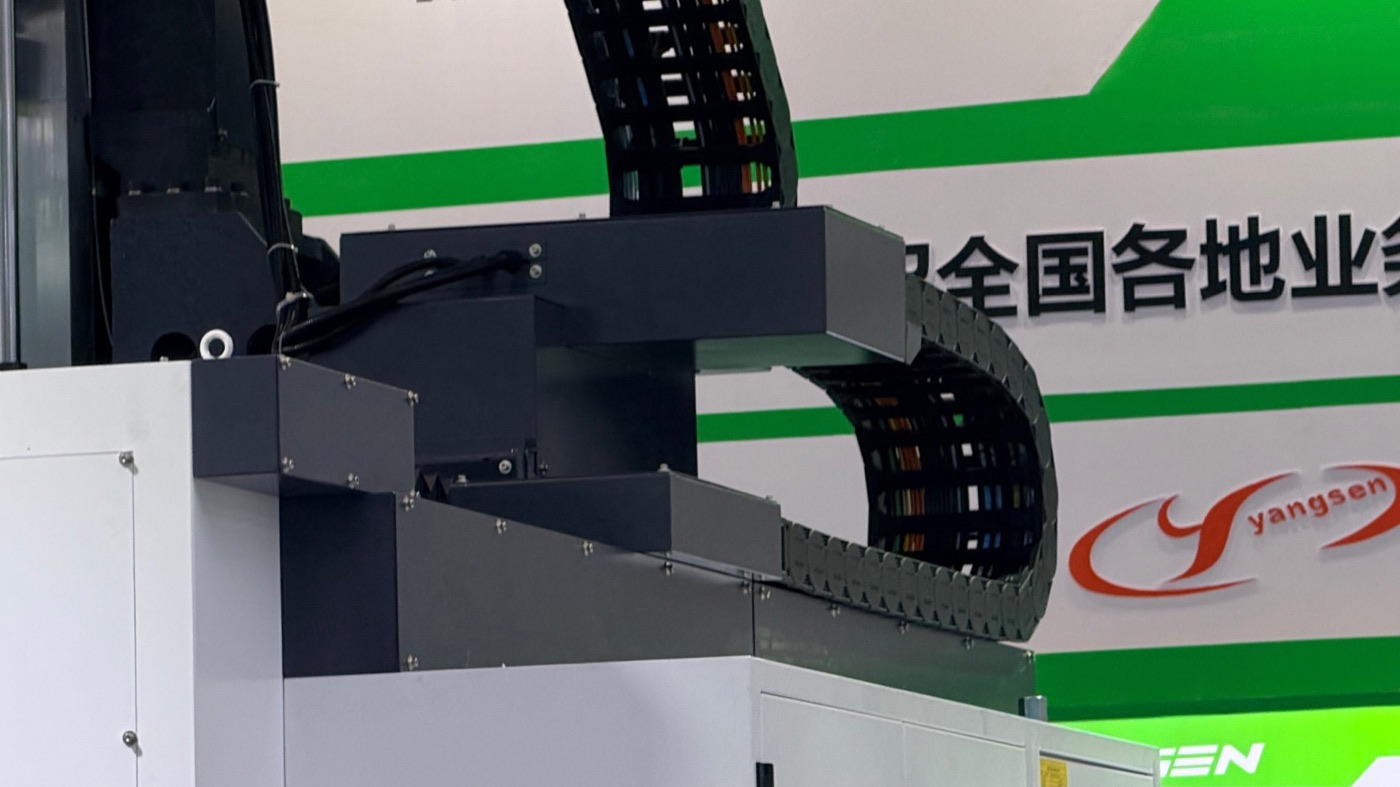
Why EDM Is a Separate Specification
A cable carrier on a milling machine sees chips and coolant spray. A carrier on an EDM or wire-cut machine sits inside the working fluid. On a submerged wire EDM the lower guide arm, the flushing nozzles and often the whole chain run under deionised water for the entire shift; on a die-sinking machine the chain lives in a mist of dielectric oil and metal sludge. That changes the material of the links, the material of the pins, the way the chain drains, and the way the cables are shielded.
Most carrier failures on EDM machines are not mechanical. They are chemical and electrical: a link that swells in oil, a pin that corrodes in deionised water, a joint packed with conductive sludge, or a shield that opens because the cable was chosen for flex and not for the dielectric it sits in.
Water and Oil Are Two Different Chains
Wire EDM and sinker EDM are usually discussed together and specified completely differently.
| Machine type | Fluid exposure | Dominant risk | What changes in the chain |
|---|---|---|---|
| Submerged wire EDM | Deionised water, full immersion | Corrosion of pins and springs, water trapped in joints | Stainless or coated pins, drainage slots, no plain carbon steel |
| Wire EDM with splash only | Water spray and mist | Sludge packing in the joints | Open joints plus a splash shield, frequent cleaning |
| Die-sinking EDM, oil | Kerosene or synthetic dielectric, mist and splash | Swelling and softening of plastics | Oil-resistant PA or PPS links, no PVC or PC parts |
| Small-hole EDM | Water or oil, fine strokes | High cycle count on a short chain | Short-pitch series, low-friction joints |
| EDM with automatic tool changer | Oil mist plus graphite dust | Abrasive paste in the joints | Hard-coated pins, sealed or self-clearing joints |
Do not accept one chain specification for both machine types. A chain that performs well under oil may corrode in water, and a water-rated chain with drainage slots will pass oil mist straight into the cable bundle.
What the Dielectric Does to Plastics and Pins
Two failure mechanisms dominate, and both are slow enough to be missed during commissioning.
Swelling. Kerosene-based dielectrics penetrate polyamide and polycarbonate. A link that measures 40 mm out of the box can grow by 0.5 to 1 mm over a year of oil exposure, which is enough to change the running clearance, make the chain stiff and increase the pull force on the axis. Glass-fibre reinforced polyamide resists this better than unfilled, and PPS is better again, at a cost.
Corrosion. Deionised water is aggressive because it is free of dissolved ions and will take them from whatever it touches. Plain steel pins, spring clips and zinc-plated brackets all corrode. Specify stainless steel pins, or a pin with a hard coating that is continuous over the bearing surface, and stainless brackets wherever the chain can be wetted.
- Ask for the dielectric the supplier tested against, not just a general "oil resistant" claim.
- Ask for the swelling figure after 500 hours of immersion, in percent.
- Check that no part of the chain or its accessories is zinc plated if the machine runs water.
- Confirm the pin material in writing; "stainless" without a grade is not a specification.
Sludge: An Abrasive That Should Not Be There
EDM sludge is eroded metal and electrode material suspended in the dielectric. It is finer than any machining chip, it is conductive, and it settles wherever the flow is slow. Inside a carrier it settles into the joint clearance and into the gap between the cable and the cavity wall.
The consequences are threefold. The joint wears faster because the sludge is abrasive. The chain becomes conductive across links, which matters on a machine that is trying to keep the workpiece isolated. And the cable jacket chafes against a packed layer of particles instead of against smooth plastic.
- Flush the joints with clean dielectric at every service, not with water or solvent.
- Choose a joint geometry that self-clears: a defined clearance and a smooth pin, not a labyrinth that traps.
- Keep the chain out of the sludge sump. Mount it as high on the machine as the geometry allows.
- On a submerged machine, check whether the flushing flow reaches the chain; a dead zone in the tank is where the sludge collects.
Cable Choice When the Chain Sits in Dielectric
The cable has to survive the fluid as well as the flexing. A standard continuous-flex cable with a PVC jacket is the wrong choice for both reasons.
| Property | Specify for EDM | Why |
|---|---|---|
| Jacket | PUR, or TPE where oil resistance is critical | PVC hardens and cracks in oil; it also leaches plasticiser into the dielectric |
| Shield | Braid, plus foil where the signal is low level | EDM generates high-frequency noise that couples into unshielded encoder lines |
| Drain wire | Separate, brought out at both ends | A shield terminated at one end only is an antenna, not a shield |
| Conductor | Fine strand, class 6 | Short-stroke EDM axes reverse at high frequency |
| Jacket colour | Any, but avoid porous or fabric-wrapped jackets | Fabric wicks dielectric and holds sludge against the conductor |
Signal cables deserve particular care on a wire EDM. The gap voltage and the spark current are the noisiest signals on the machine, and the wire path encoder is the most sensitive. Run the encoder cable as far as possible from the power cables inside the same chain, and use a vertical separator rather than taping the two together.
Draining and Splash Control
A submerged chain comes out of the tank full of fluid. On the return stroke it carries that fluid up and drops it onto the machine table, the linear guides and the floor. Two details fix it.
- Specify links with drainage slots or open bottoms if the chain is immersed; a closed link holds a cup of dielectric at every reversal.
- Mount the fixed end with a slight fall towards the tank, so the chain drains back rather than onto the machine.
- Fit a simple drip tray under the moving end if the machine cannot tolerate fluid on the table.
- On splash-only machines, a sheet-metal shield above the chain keeps the spray off the joints without sealing the chain.
If the chain must be fully sealed against fluid, choose a sealed-joint series and accept the higher pull force. A sealed chain that is not rated for continuous immersion will fill up anyway, and then it cannot drain.
Mounting on the Z Ram and Around the Wire Path
On a wire EDM the Z axis is short and fast, and the space around the wire path is crowded with flushing lines, the wire tension mechanism and the lower guide arm. Three practical points.
- Keep the chain out of the wire path. A chain that crosses the wire run will eventually catch a broken wire and jam.
- On a short Z stroke, a vertical chain with both ends fixed and a small loop is usually better than a horizontal run, because it drains and takes less table space.
- Route the flushing hoses on the outside of the bend and use a separator; a hose that crosses the cable bundle will chafe through both.
- Leave enough slack at the ram connection for the service travel; technicians need to move the head by hand with the chain connected.
Inspection on an EDM Machine
The inspection interval on EDM should be shorter than on a machining centre, because the failure modes are slow and hidden. Check five things every 500 hours.
- Joint stiffness. Move the chain by hand through its full travel. A joint that has swollen or packed with sludge feels stiff at the reversal.
- Pin corrosion. Look for rust bloom or white corrosion product at the pin ends, especially on the lower run.
- Conductivity. With the machine isolated, check resistance between two links a metre apart. A reading that falls over time means sludge is bridging the joints.
- Jacket swelling. Measure the cable diameter at the clamp and at mid-span. More than 5 % growth means the jacket is absorbing dielectric.
- Drainage. After a shift, look for fluid standing in the lower links. Standing fluid means the drainage path is blocked.
Specification Checklist for EDM
- Machine type: submerged wire, splash wire, die-sinking, small-hole, or a combination.
- Dielectric: deionised water, kerosene, synthetic, and the concentration or conductivity if relevant.
- Whether the chain is immersed continuously, splashed, or only exposed to mist.
- Axis stroke, cycle rate and the required design life in cycles.
- Full cable list with jacket material, diameters and bend radii, plus the encoder and power cable separation required.
- Drainage requirement, and whether fluid on the machine table is acceptable.
- Ambient and fluid temperature range, which decides between standard and high-temperature link materials.
With those seven answers the link material, pin material, joint geometry, drainage arrangement and cable specification all follow, and the chain you receive will be built for the fluid it actually lives in rather than for the machine category it belongs to.
Choosing a cable carrier for EDM or wire-cut work?
Tell us the machine type, axis size, cable count, speed and what the chain is exposed to — chips, dust, coolant or dielectric. We reply with the series and material grade that fit, usually within one working day.
Overhead Cable Carrier on a Gantry: Support, Sag and Safety
Cable Carrier for Engraving Machine and CNC Router: Sizing Guide
Related Article